
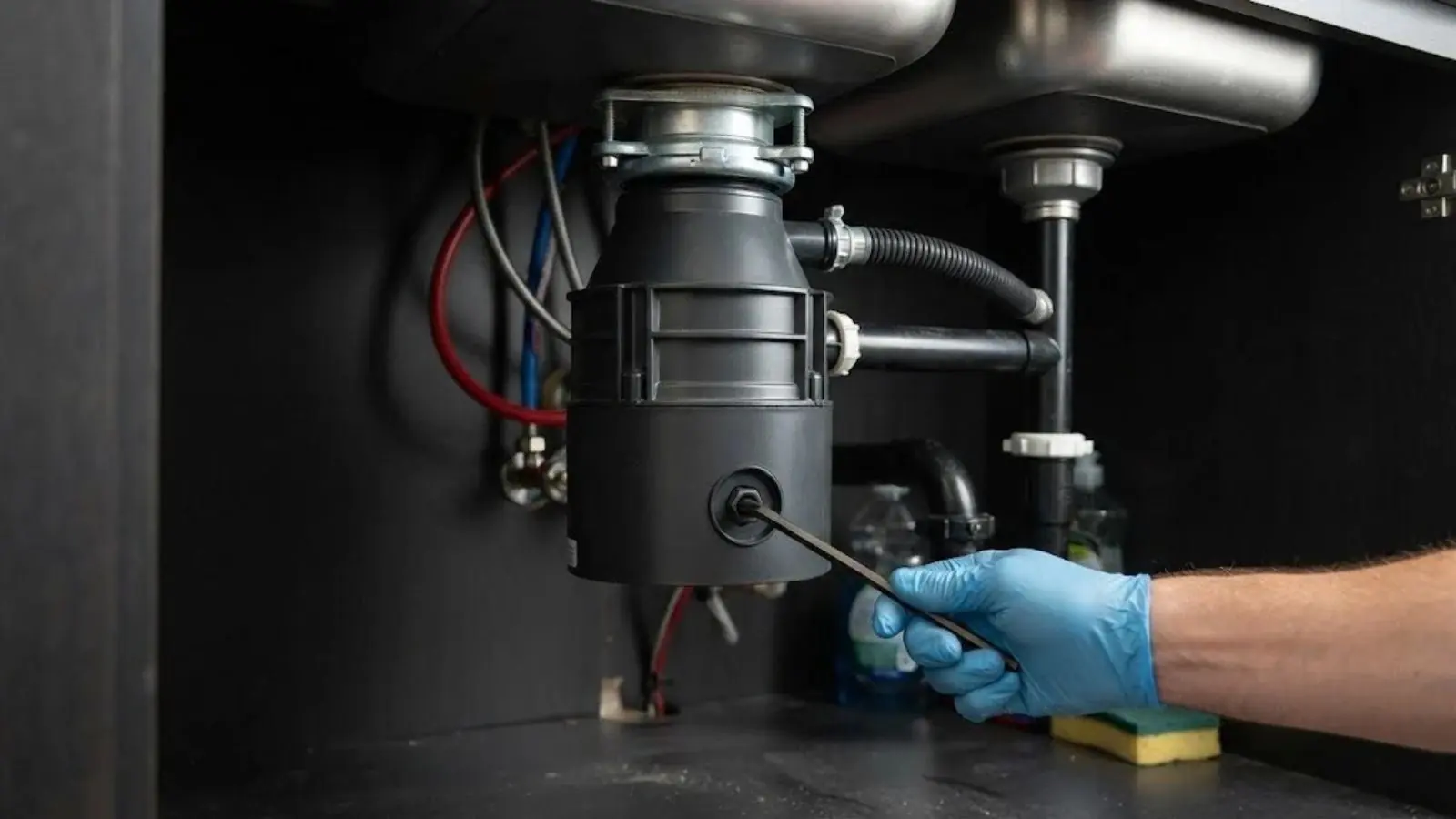
If your garbage disposal hums but the blades will not turn, the blades are almost always jammed. Switch it off, press the red reset button on the underside of the unit, and free the blades with a hex key from below. Never put a hand or fingers inside, even when the power looks off.
A disposal that is silent usually tripped its overload and needs the reset button. One that leaks is a different problem, and the water tells you where to look: the ring at the sink, the dishwasher hose or the metal housing itself.
This guide covers each case in order, shows when a repair makes sense and when a replacement is smarter, and flags the moments to stop and call a licensed plumber. Condo kitchens get their own notes, because what goes down your drain does not stay in your unit.
Free a jammed disposal in five steps
Do these in order. The first step matters most, because a disposal that powers on while your hand is near it can cause a serious injury.
Cut the power
Flip the wall switch off, then unplug the unit from the outlet under the sink. If it is hardwired, switch off its breaker at the panel instead.
Look in with a flashlight
Do not reach in. Use tongs or long pliers to lift out anything you can see, such as a bottle cap, a fruit pit or a piece of silverware.
Turn the blades from below
Most units have a hex socket at the center of the underside. Fit the hex key in, then work it back and forth until the blades turn a full circle.
Press the reset button
A small red button sits on the bottom of most disposals. Push it in firmly. If it clicks or stays in, the overload has reset.
Restore power and test
Plug it back in or turn the breaker on, run cold water, then switch the disposal on. If it hums again, stop and read the next section.
If the key will not turn the blades at all, or the button pops out again right away, do not keep forcing it. A seized motor or a bent shredder plate needs a plumber, not more torque.
Humming, silent or tripping: what each one means
The sound a disposal makes narrows the cause quickly. Use this list before you buy parts.
- A hum and no spinThe motor has power but the blades are stuck. That points to a jam, and the hex key step usually clears it.
- Total silence when you flip the switchThe overload protector has likely tripped. Press the reset button. If it is still dead, check the outlet and the breaker.
- It runs, then shuts off after a few secondsThe motor is overheating, often from a partial jam or a worn motor. Repeated trips mean the unit is nearing the end of its life.
- Grinding or rattling metalSomething hard is loose in the chamber. Switch it off at once, then pull the item out with tongs.
- Spins freely but food does not clearThe blades turn but the drain below is slow. A clogged trap or branch drain, not the disposal, may be the real problem.
That last case is common. If the sink fills with gray water even though the motor sounds healthy, our drain cleaning service is the better call than a new disposal.
Where the water under the sink is coming from
Dry the cabinet floor and the underside of the disposal with a towel, then run the sink and watch. Water that shows up first tells you the source. Put a sheet of paper towel under the unit to catch the drip location.
Do the dishwasher test separately. Run only the dishwasher drain cycle with the sink dry, and see whether the leak appears. That one test separates the hose from everything else.
The sink flange
If water drips from the top ring where the disposal hangs from the sink, the putty or gasket seal has failed. Leaks here show up whenever the sink runs, not just when the disposal runs. A plumber can reseat the flange, which means removing the unit from its mount.
The dishwasher hose
A small hose connects the dishwasher drain to a nipple on the side of the disposal. If the clamp loosened or the hose cracked, water leaks only during a dishwasher cycle. Tightening a clamp is simple, but a cracked hose needs replacing.
The housing or bottom seal
Water coming from the metal body or from the bottom near the reset button means an internal seal has failed or the casing has corroded. This is not a repair job in practice. The unit should be replaced, and you should stop using it until then.
Repair or replace: a decision table
Some faults are cheap fixes and some are not worth chasing. This table lines them up by what you found.
| What you found | Likely cause | Usually best move | Do it yourself? |
|---|---|---|---|
| Hum, blades stuck | Jam | Clear it with the hex key and reset | Yes, with power off |
| Dead, button pops out | Overload or seized motor | Replace if it trips again | Reset only |
| Drip at the top ring | Flange seal | Reseat the flange | Plumber advised |
| Drip only with dishwasher | Hose or clamp | Tighten or replace the hose | Often yes |
| Leak from the housing | Corroded or cracked body | Replace the unit | Plumber advised |
| Unit is old and trips often | Worn motor | Replace instead of repairing | Plumber advised |
When a replacement is the answer, our garbage disposal repair and replacement team handles the swap, including the mount and the dishwasher connection.
What Hallandale Beach condo kitchens change
Census data puts about 70 percent of Hallandale Beach housing units in buildings of 20 or more, using the five-year survey table of units in structure. In those buildings your sink drains into a shared stack, so grease that sticks to a pipe in a wall can back up into a neighbor's unit as well as yours. Ask your condo association about its rules on disposals before you add one.
The City of Hallandale Beach Utilities Division, according to its own utility page, runs a sewer collection system with 16 lift stations and sends the wastewater on to Hollywood's regional plant for treatment. That is a public system with pumps, and the city page does not address kitchen grease. The practical rule is simple: keep fat, oil and coffee grounds out of the disposal, and scrape plates into the trash first.
Keeping a disposal out of trouble
Run cold water before, during and for about fifteen seconds after each use, so waste clears the whole drain and not just the chamber. Feed scraps in small amounts. Fibrous food such as celery, corn husks and artichoke leaves wraps around the blades, and starchy leftovers like rice or pasta swell into paste.
Skip grease, bones, fruit pits and anything that is not food. Citrus peel is fine in small pieces. If the unit smells, ice cubes and a splash of dish soap help, but a persistent odor often means buildup in the trap below.
When to stop and call a plumber
Stop DIY work if the unit has water leaking from the body, if the reset button keeps tripping, or if the hex key will not move the blades after a careful try. Stop also if you see sparks, smell burning, or notice water near the outlet or the cord. Shut off the breaker first, and keep your hands out of the wet area.
A disposal swap involves electrical connections, a dishwasher drain and a drain trap. If a leak has soaked the cabinet floor, ask a plumber to check for hidden damage. Our crews can also look at the supply side when a faucet that drips onto the same cabinet is part of the problem. Permit rules vary, so if you are unsure whether a swap needs one, ask the city Building Division.
Questions homeowners ask
The motor is getting power while the blades are locked by a jam. Turn the power off, use a hex key in the socket on the underside to rotate the blades back and forth, and press the reset button. Never use your hand to free it.
It is usually a small red button on the bottom of the unit, under the sink. Press it firmly after the motor has cooled for a few minutes. If it will not stay in or trips again, the unit has a deeper fault.
No. A leak from the sink flange or a loose dishwasher hose is often repairable. A leak from the body or the bottom seal usually means the housing has failed, and replacement is the sensible route.
Do not. Chemical cleaners do not free a jammed blade, and they can splash back or sit in the chamber for the next person who works on it. Mechanical clearing is the safer choice.
Check with your association first. In a multi-unit building, kitchen drains feed shared stacks, and some buildings restrict disposals or set rules about what may go down. Ask management for the written policy before you buy one.
Run cold water the whole time, and for a short while after you switch it off. Water carries the ground waste through the trap and into the main drain, which reduces clogs downstream.
Sources and official references
The governing standard for plumbing work in Florida is the Florida Building Code, Plumbing (8th Edition, 2023), with the 9th Edition scheduled to take effect December 31, 2026. This page is general information and not a code interpretation, so confirm requirements with the city Building Division.