
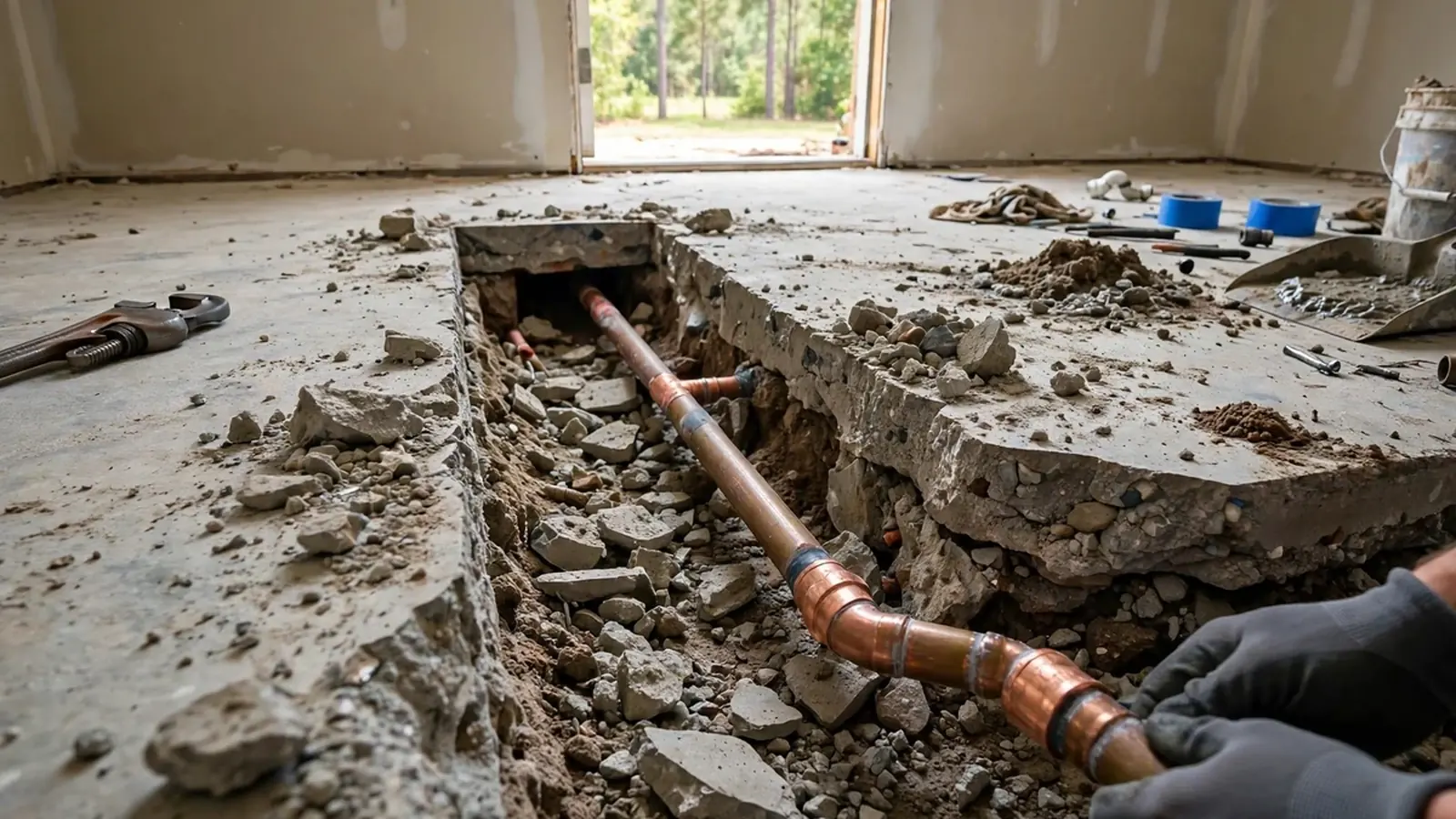
Emergency slab leak repair in Hallandale starts with one call to the 24/7 line. While you wait, close the main water shutoff and keep everyone out of wet areas, away from outlets and plugged-in appliances. If the floor is warm in one spot or the meter spins with everything off, say so when you call.
A slab leak is a leak in a pressurized supply line, or sometimes a drain line, that runs under or inside a concrete floor. It can be a hot line, which often warms the floor above it, or a cold line, which tends to show up as damp spots, a musty smell or a rising bill.
We find the leak first, then walk you through the options. In many cases a precise location means a small opening in the floor, not a large one.
Why slab leaks are common in South Florida
Slab foundations are common across South Florida, so many homes and ground-floor units have supply lines that run through or beneath concrete. Over time, pipes can wear where they touch the slab, at joints and where they bend, and a pinhole leak can run for months out of sight.
The Census dates the median Hallandale Beach home to 1975, and most units (about 70 percent) sit in large buildings of 20 or more. Older supply lines in older buildings have had decades to wear, and in a condo a leak beneath your floor can reach a neighbor's unit or a shared area. Tell building management early.
Which side of the meter is it on?
The City of Hallandale Beach Utilities Division advises that a meter still running after the water is shut off signals a break on the customer's side. Shut off the main valve at your building and watch the meter. If it stops, the leak is inside, and we trace it.
Flooding through the floor or a spinning meter: do this first
A leak under a slab can flood a home from below or drive a bill up quickly. If any of these describe your home, ask for a same-day or late-night visit.
Water is coming up through the floor or at a wall base
Close the main shutoff. Move belongings off the floor and, if you can reach the panel without stepping in water, switch off power to the wet area.
The meter keeps running with every fixture off
Close the main valve. A meter that stops means the leak is inside. A meter that keeps turning suggests trouble before your valve, so tell us and call the utility.
A section of floor is hot to the touch
Hot water leaking beneath tile can heat the surface above it. Turn the water heater off to stop feeding the leak and call the 24/7 line.
A neighbor reports water or staining below you
In a condo, tell management and phone us at once. Quick isolation limits damage and paperwork.
How we find and confirm a slab leak
The aim is a precise location so any opening is as small as possible. We move from the simplest test to the more detailed ones.
Meter and pressure test
We isolate parts of the system and read the gauge to learn whether the loss is hot or cold, supply or drain.
Listen with acoustic equipment
Ground microphones and pipe sensors hear water escaping and shrink the search to a few feet.
Scan with thermal imaging
A thermal camera picks up heat from a hot line and cooling where moisture evaporates.
Confirm with moisture readings
A moisture meter confirms the wet spot before any cutting starts.
Explain the repair options
You get the location, the cause and the choices, with the trade-offs, before any floor is opened.
If you are not sure the problem is under the slab, leak detection checks the whole system first.
Spot repair, reroute or repipe: the options compared
The right fix depends on the pipe's age and condition, where the leak is and how many other weak spots exist. This table shows how the three main options compare.
| Option | What it involves | Best when | Trade-off |
|---|---|---|---|
| Spot repair | Open the slab at the leak and repair or replace that section | One leak in an otherwise sound line | Opens the floor, and other weak spots may remain |
| Reroute | Abandon the leaking line and run a new one overhead or through a wall | A line that has leaked more than once or is hard to reach | More work in walls and ceilings, less in the slab |
| Repipe | Replace the supply lines in the home or unit | Older piping with several weak points | Largest job, with the longest-lasting result |
| Pipe lining or coating | Restore a pipe from the inside where it suits the line | Some lines where access is hard | Not suitable for every pipe or damage type |
Where a line has failed more than once, repiping the supply lines often costs less over time than repeated floor openings.
Signs of a slab leak
Slab leaks can be quiet. These are the signs we hear about most, and any one is worth a call.
- A water bill that rises with no change in habitsWith every fixture off, read the meter. A moving dial or leak indicator means water is escaping on your side.
- Warm spots on the floorHot water leaking beneath tile warms the surface above it, and bare feet notice before eyes do.
- The sound of running water in a quiet homeHissing or trickling with every tap closed points to a pressurized line leaking.
- Damp carpet, lifted tile or cracked groutWater pushing up from below can lift flooring and loosen grout lines.
- A musty smell or mold near baseboardsConstant moisture at the slab edge feeds mold along the lower wall.
- Low water pressure at several fixturesA leak ahead of the fixtures steals pressure, and the drop tends to grow with time.
If you see more than one of these signs, treat it as a likely slab leak and call. Waiting turns a repair into a larger one.
What drives the cost of slab leak repair
Pricing a leak nobody has located would be a guess. A clear price comes before work starts, and these items drive it.
Coverage often reaches sudden water damage but may skip the cost of finding or fixing the pipe, and policies differ on slow leaks. Your insurer or association can explain yours. For a real figure, phone the 24/7 line.
While you wait for the plumber
Close the main shutoff, run the lowest faucet to bleed off pressure, and switch off the water heater if the leak is on the hot side. Photograph damp spots, stains and the meter reading with the date.
Please do not break up the floor yourself. Pinpointing the leak first usually keeps the opening small.
Questions homeowners ask
Yes, and the phone is staffed at all hours. While you wait, tell the dispatcher what you can see, including whether any floor is warm.
Warm floor spots, a spinning meter with everything off and the sound of running water point to a slab leak. Our leak detection visit confirms it with pressure tests and listening gear.
Sometimes, through rerouting or lining. A reroute runs a new line through walls or ceilings, and lining works from inside the pipe. Spot repair needs a small opening in the slab. We explain which options suit your pipe.
It depends on your association's documents. Lines inside your unit are usually yours, and shared lines are usually the association's. We locate and document the leak, and you share that with management.
It depends on the line. A single leak in a sound line suits a spot repair. A line that has leaked more than once, or that is hard to reach, often suits a reroute or a repipe.
If the leak was losing water, your usage should return toward normal after the repair. Check the meter with fixtures off to confirm, and watch the next bill.
Some do, depending on the work. Permit rules vary, so ask the Hallandale Beach Building Division about your address. If a repipe or reroute is involved, we tell you what we see on the visit.
Sources and official references
The governing standard for plumbing work in Florida is the Florida Building Code, Plumbing (8th Edition, 2023), with the 9th Edition scheduled to take effect December 31, 2026. This page is general information and not a code interpretation, so confirm requirements with the city Building Division.