
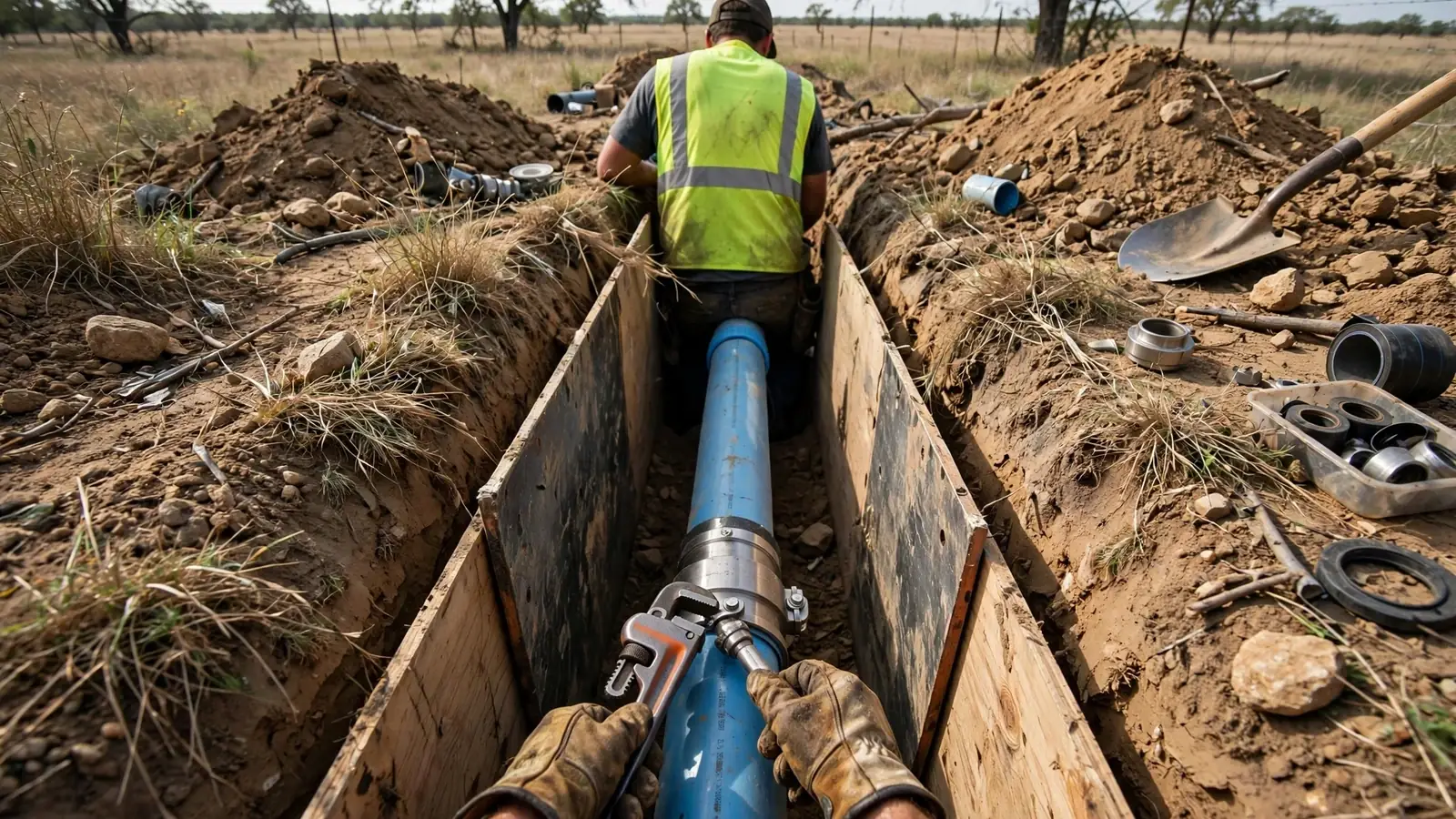
Emergency water line repair in Hallandale starts with a call to our 24/7 line, then a trip to your main shutoff. If the water is running through a yard, a driveway or a ceiling, close the valve at the building and tell us whether the meter keeps moving afterward. That one detail tells the plumber where to start.
Your water service line is the buried pipe that carries water from the city meter to the building. When it cracks, corrodes or gets pulled apart by roots, soil movement or digging, the symptoms are a high bill, a wet patch, weak pressure or a meter that never stops.
We find the break, explain whether a spot repair or a replacement makes sense, and tell you the price before the work begins.
How we find and repair a failed water line
A buried line cannot be judged by looking at the surface. The order below keeps digging to a minimum and gets you running water again as soon as the repair allows.
Confirm the break is on your side
We close the building shutoff and watch the meter. If it stops, the leak is downstream of the valve. If it keeps running, the problem may be between the valve and the meter, and we explain the next call to make.
Isolate and pressure test
We separate the service line from the building plumbing and test each part to learn which run is losing pressure.
Locate the leak
Acoustic listening gear and pipe tracing narrow the break to a short stretch, so the excavation is small and the landscaping, paving or slab is disturbed as little as possible.
Excavate and expose the pipe
We dig to the damaged section, check the pipe on both sides for corrosion or damage and mark where the sound pipe begins.
Repair or replace the run
A cut-in coupling can fix a single break on sound pipe. When the pipe is worn along its length, we recommend replacing the run, usually with polyethylene or copper depending on the situation.
Pressure test, backfill, restore
The line is tested before the trench is closed, and we tell you which surface restoration is left for another trade.
If the break turns out to be a branch inside the building and not the buried line, a burst pipe fix on that branch is the next step.
Repair or replace: how the options compare
Not every broken line needs a new one. This table shows how the common situations usually line up with the choices.
| Problem | Telltale sign | Usual response | Trade-off |
|---|---|---|---|
| Single break on sound pipe | Wet spot, rest of line tests fine | Spot repair with a coupling | Lower cost, but older pipe may fail elsewhere later |
| Corroded or brittle pipe over a long run | Repeated leaks, discolored water, falling pressure | Replace the run | Higher cost, fewer return visits |
| Leak between meter and valve | Meter runs with the main closed | Coordinate with the utility | Ownership of that stretch has to be confirmed first |
| Damage from digging or roots | Sudden loss of flow after outside work | Repair or reroute the damaged length | Surface restoration adds work |
| Unknown or older pipe material | Material not recorded | Identify at excavation, then decide | Depends on what the pipe turns out to be |
If you are not sure where the water is escaping, start with a leak detection visit. Locating the leak first usually saves digging in the wrong place. If the pipe is worn along its whole length, a repiping project inside the building may be worth planning at the same time.
Meters, city guidance and who owns which pipe in Hallandale Beach
Water production, distribution and wastewater in the city sit with the Utilities Division under Public Works. Its meter advice is direct: a meter still running after shutoff means a plumber should look for a break on the customer's side. In practice, check the meter with every fixture closed, then close the main and check again.
The city also posted an EPA Tier 3 public notice for being late on its initial lead service line inventory. That is a paperwork notice. It does not tell us that any given address has a lead line. If you want to know what your service line is made of, ask the Utilities Division, and tell the plumber before any excavation so the pipe can be identified when it is exposed.
Condos and shared lines
Many buildings here have one master service line and meter feeding the whole property, with the association responsible for the pipe up to the units. If the problem is outside your unit, report it to management first, then call us if your own plumbing is also affected.
Water quality and pipe wear
We do not point to the water supply as the cause of a failure. What matters to you is pipe age, material and soil conditions, which is why we inspect the pipe itself and not the water report.
What affects the cost of a water line repair
A buried line cannot be priced from the phone, since the number depends on what is found underground. You hear a clear price before work starts.
Insurance typically covers sudden damage inside a building. Coverage for a buried line on your side varies by policy and by whether you carry a line endorsement, so ask your insurer. Ready for a real number? Call the 24/7 line.
Signs the water line is the problem
A broken line shows up in a handful of ways. Any one of them is worth a call, and two together almost always mean a break.
- The meter moves with every fixture offLook for the leak indicator or a spinning dial. A slow leak often shows as a steady creep. Some meters run for several hours before the dial settles.
- A high bill with no change in useCompare the last few bills. If the number climbs without a reason, check the meter before you assume it is the city.
- Soggy lawn, sinkhole or wet pavement near the meter boxWater collecting in the yard when it has not rained points to a failed line or a fitting at the box.
- Low water pressure through the whole buildingWhen every faucet is weak at once, the supply is the usual suspect. A partial break or a corroded line can restrict flow before any wet spot appears.
- Water discolored or sputtering when you open a tapRust-colored water and air in the line can mean the pipe is corroding or has been damaged.
Water gushing in the yard or no water at all: what to do now
A failed service line can flood a yard or leave a home dry in minutes. These steps limit the damage while the plumber is on the way.
Water is flooding the yard or driveway
Close the main shutoff at the building. If the water keeps coming from the ground, the break may sit before your valve, so call us and the city's Public Works line at (954) 457-1616.
No water at all after digging nearby
Stop any work on the site. Do not probe the ground with tools, since a nick on a pressurized line makes things worse. Tell us who was digging.
Water in the garage, utility room or lowest floor
Move belongings off the floor, keep electrical gear dry and stay out of the water near outlets.
The water runs but is brown, or pressure collapsed
Run a cold tap for a minute. If it does not clear or the pressure stays low, call us and note what you see.
Before the plumber arrives and what to ask about your line
Photograph the meter reading and any wet ground, with the date. Know where the shutoff is and, if you can, how old the building plumbing is. Ask the Utilities Division what it has on record for your service line material, and share the answer with us.
If the job means digging, find out from the Hallandale Beach Building Division whether a permit applies, because requirements vary. Owners just north of the city line can also reach us through our Hollywood service area. We tell you what we expect to be needed once we see the line.
Questions homeowners ask
Yes. Nights, weekends and holidays are covered by the same 24/7 line, and a licensed plumber can be sent for running water or a total loss of supply. Close the main and watch the meter while you wait.
Shut every tap, appliance and irrigation zone, then watch the meter's leak indicator or dial. Any movement means water is escaping. Close the main shutoff and check again. If it stops, the leak is inside your system. If it keeps running, the city should be involved.
The city's guidance is that a break on the customer's side of the meter is for a plumber to find. Where your responsibility starts and ends depends on the property, so ask the Utilities Division.
Often, yes. Leak location narrows the dig to a short stretch. Some replacements need a longer trench, and we tell you which situation you have before work starts.
Possible causes include a partly closed valve, a corroded section, a pressure regulator that is failing, or a leak ahead of the fixtures. We check the line and the regulator before we propose a repair.
Homeowners can ask the city's Utilities Division what is on record for their service line material. The city posted a Tier 3 notice about its lead line inventory, but that does not say your line is lead. If we expose the pipe, we tell you what it is.
Requirements depend on the scope, so ask the city's Building Division before work begins. We tell you when we expect a permit to be part of the job.
Sources and official references
The governing standard for plumbing work in Florida is the Florida Building Code, Plumbing (8th Edition, 2023), with the 9th Edition scheduled to take effect December 31, 2026. This page is general information and not a code interpretation, so confirm requirements with the city Building Division.