
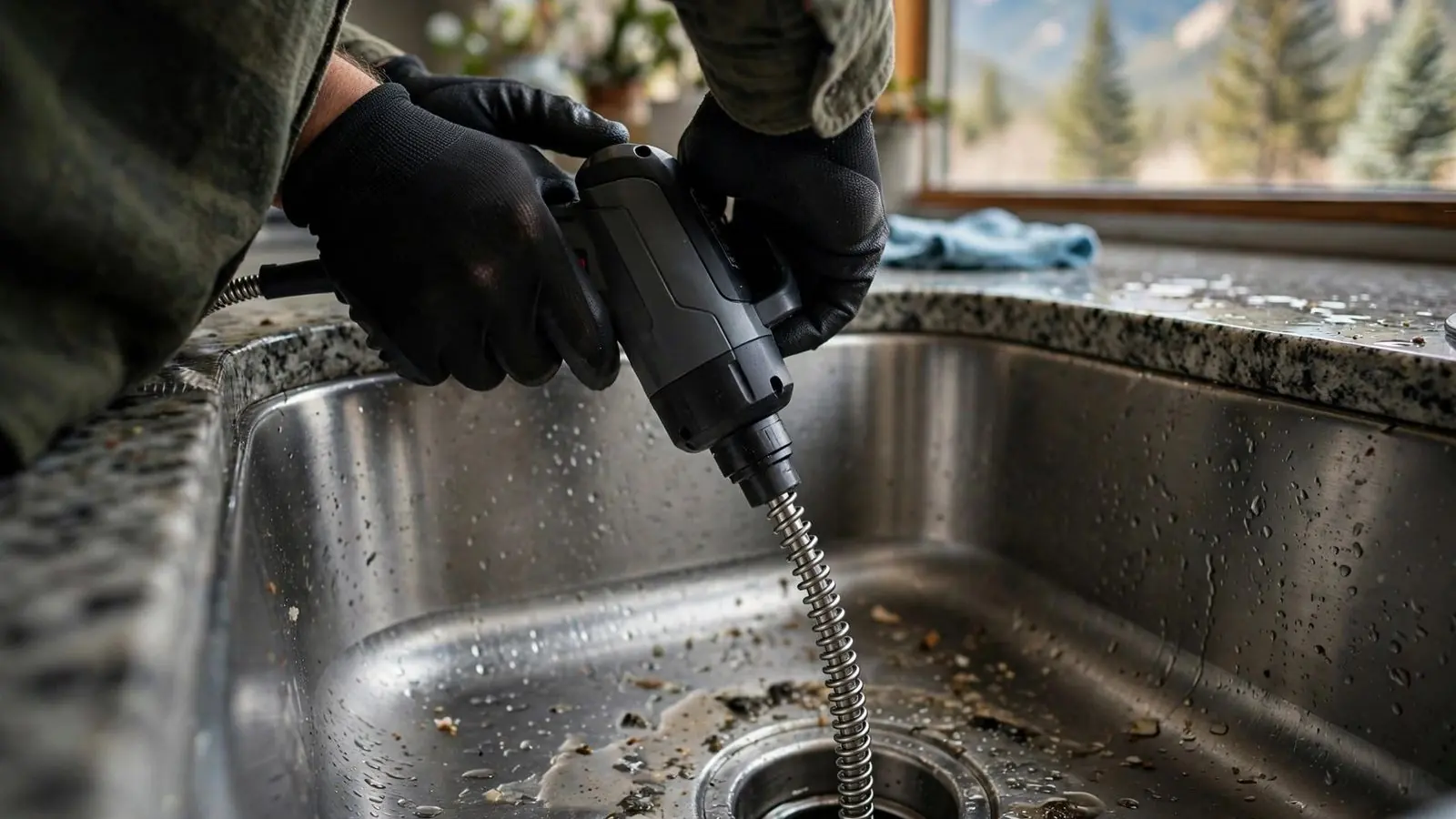
To fix a leaky kitchen faucet, find out where the water appears, shut off the supply valves under the sink, identify the faucet type, and replace the worn part inside the handle or spout. Compression, cartridge, ball and ceramic disk faucets each wear out in a different place, so the right part depends on the type. A drip from the spout is a different problem from a puddle under the cabinet.
Below you will find the four faucet types, a general repair sequence, how to tell a bad faucet from a bad supply line, and when a plumber should take over. Our faucet repair service handles every type if you would rather not do it yourself.
The four faucet types and what wears out in each
Look at how the handle moves and how many handles there are. That tells you most of what you need, and it decides which replacement part to buy.
| Faucet type | How to recognize it | Where it usually leaks | Usual wear part |
|---|---|---|---|
| Compression | Two handles that turn several times to open and close | Spout drip when closed, or at the handle | Rubber washer and valve seat |
| Cartridge | One or two handles, smooth motion with a firm stop | Spout drip or around the handle base | Cartridge and its O-rings |
| Ball | One handle on a rounded cap, moves in a circle | Base of the spout or under the handle | Seats, springs and O-rings |
| Ceramic disk | One lever, very smooth and quiet movement | Spout drip or at the lever base | Disk cartridge or its seals |
If you cannot tell which type you have, take a photo of the faucet and of the parts once the handle is off. That photo is the most useful thing you can bring to a supply store or show a plumber.
Work out where the water is really coming from
Before taking anything apart, dry the area with a towel and watch where the first drop appears. The location points to the failed part.
- Drips from the spout when the faucet is offThe internal seal, washer or cartridge is no longer closing completely. This is the classic repair and the one most people can handle.
- Water pooling around the base of the faucetO-rings in the body are usually worn. On a ball faucet this is especially common, and the sink deck can hold water that looks like it came from elsewhere.
- Wetness under the handle or leverThe packing, O-ring or cartridge seal around the handle stem has given way.
- Dampness on the cabinet floor with a dry faucetLook at the supply lines and the shutoff valves under the sink. The faucet is not the source if the top of the sink stays dry.
- Pressure that falls off along with the leakA weak flow with a dripping spout can mean mineral buildup in the aerator or cartridge, so clean those before replacing parts.
A paper towel under each connection is the easiest test. Wrap it around a joint, wait a few minutes, and the wet one is your leak.
A general repair sequence for the spout drip
This is the common order of work. Brands differ in how the handle comes apart, so use the photo you took and the part itself as your guide.
Close the shutoff valves under the sink
Turn the hot and cold valves clockwise until they stop. Open the faucet to release pressure and confirm no water comes out. If a valve will not close or starts leaking at its stem, stop and call a plumber instead of forcing it.
Plug the drain and lay out a towel
Small screws and rings fall down drains easily. Block the opening and set the parts on a towel in the order you remove them.
Remove the handle
Look for a decorative cap, then a small set screw or screw under it. Lift the handle off and expose the stem or cartridge.
Pull the worn part
Compression faucets have a stem with a washer, cartridge faucets have a cartridge held by a clip or nut, ball faucets have a cam and seats, and ceramic disk faucets have a cylinder cartridge.
Match the replacement
Take the old part to a supply store or compare it with the replacement before you install it. Size, number of splines and seal type must match.
Reassemble and test slowly
Rebuild in reverse order, open the shutoff valves gradually, then run the faucet and check for drips at the spout and at the base for a few minutes.
Faucet problem or supply line problem
A leaking kitchen faucet and a leaking supply line look similar from the dining room because both end in a wet cabinet. The difference matters because the repair is different. A faucet needs a cartridge or washer. A supply line is a flexible hose that connects the shutoff valve to the faucet, and it gets replaced whole when it weeps at the fittings or the braid looks rusty or swollen.
Shutoff valves are a third source. They can leak at the stem or at the outlet, and old multi-turn valves are known for failing the moment someone finally turns them. If your valves are stiff, corroded or dripping, a plumber can replace them with the supply line so the next repair is simple.
When the faucet itself should be replaced
Replace the faucet when the body is cracked or pitted, when the finish is flaking, when repeated cartridge swaps do not hold, or when parts for an older model are no longer sold. Replacement is also the better path if the faucet is mounted on a deck that has lost its sealing.
When a leak under the sink is not the faucet at all
Slow leaks at the drain trap, the disposal or a dishwasher connection can show up in the same cabinet. If the supply side is dry, check those, and see the leak detection service if the cabinet keeps getting wet and you cannot find the cause.
Know when to stop doing it yourself
Stop if a shutoff valve cannot be closed fully, if a fitting is corroded to the point that it spins or crumbles, or if water is coming out of the wall behind the sink. A flooding cabinet is an emergency. Close any valve you can, and if none will close, shut the main water valve for the unit or building and call the 24/7 line.
If the supply line itself has failed and the damaged section runs into the wall, you are looking at pipe work, not a faucet repair. Our water line repair team handles those cases, including shutoff valve replacement.
Why a small drip matters on a Hallandale Beach water bill
Hallandale Beach's Utilities Division, part of Public Works, runs the water system, and its utility page tells customers that if the meter keeps running after the water is shut off, you need a plumber to find a break on the customer's side. A dripping faucet adds up between meter readings, so a spout drip you ignore is a leak you are paying for.
A simple check follows from that. Close every fixture, note whether the meter dial or leak indicator moves, and compare it after the repair. If it still moves with the faucet fixed, the problem is somewhere else, and the city's Public Works line is (954) 457-1616 for general inquiries about the meter.
Condo kitchens and where we can help
About 70 percent of housing units in Hallandale Beach sit in buildings of 20 or more units, per Census data, which means a kitchen faucet job is often a condo job. The shutoff valves under the sink may be the only isolation you have, and if they fail, the next step is the building's riser valve, which management controls. Ask your association who holds the key before you need it.
If you are reading this in Pembroke Park plumbing service territory or a home near Hollywood plumbers, the repair steps above are the same. A plumber can usually do a faucet repair and a shutoff valve replacement in one visit when parts are available.
Questions homeowners ask
The valve seat or the faucet body may be pitted, or the new cartridge may be the wrong size. Mineral scale in the spout can also cause drips. If the same drip returns, a plumber should check whether the faucet is worth keeping.
Not usually. The two shutoff valves under the sink isolate just the faucet. If those valves do not close or leak, then you close the main water valve for the home or unit. In a condo that may be the riser valve controlled by the association.
Dry everything and run the faucet. If the top of the sink stays dry and water collects under the cabinet, test the supply lines and valves with a paper towel. A wet braided line or a wet valve stem means the leak is on the supply side.
Yes. A drip uses water 24 hours a day and wears the seat and finish. It also tells you a part is failing, and catching that early usually keeps the repair to a cartridge and a few minutes of labor.
Replacing the whole faucet is often simpler. A new faucet with new supply lines and shutoff valves resets the clock on every connection in the cabinet, which can be cheaper than chasing discontinued parts.
Start by closing your own shutoff valves and checking whether the meter stops. Should the meter still move with the main closed, call City Public Works at (954) 457-1616. If it stops, the leak is on your side and our dispatcher can send a plumber.
Sources and official references
The governing standard for plumbing work in Florida is the Florida Building Code, Plumbing (8th Edition, 2023), with the 9th Edition scheduled to take effect December 31, 2026. This page is general information and not a code interpretation, so confirm requirements with the city Building Division.