A hurricane season plumbing checklist for Hallandale comes down to six items. Know where your main shutoff is and test it. Understand what your drains and check valves do. Prepare the water heater and appliances. Store clean water. Plan for a boil water notice, and know what to do after the storm. Do the first two while the weather is quiet, because a valve that has not turned in years rarely cooperates during a crisis.
The Atlantic hurricane season runs June 1 to November 30, so the work is still timely late in the year. Below is the checklist in the order we would do it. If a valve will not turn or a fixture is already leaking, call the 24/7 line before the weather arrives, and see our burst pipe repair service for what a plumber does in an emergency.
Find and test your main shutoff
The main shutoff is the single most useful piece of plumbing knowledge in a storm. Locate it on a calm day, and make sure it works.
Find the valve
In a house it is usually near where the water line enters, often by the meter, in a utility closet or outside wall. In a condo, check the unit first, then ask management about the building riser valves and who holds the key.
Know the valve type
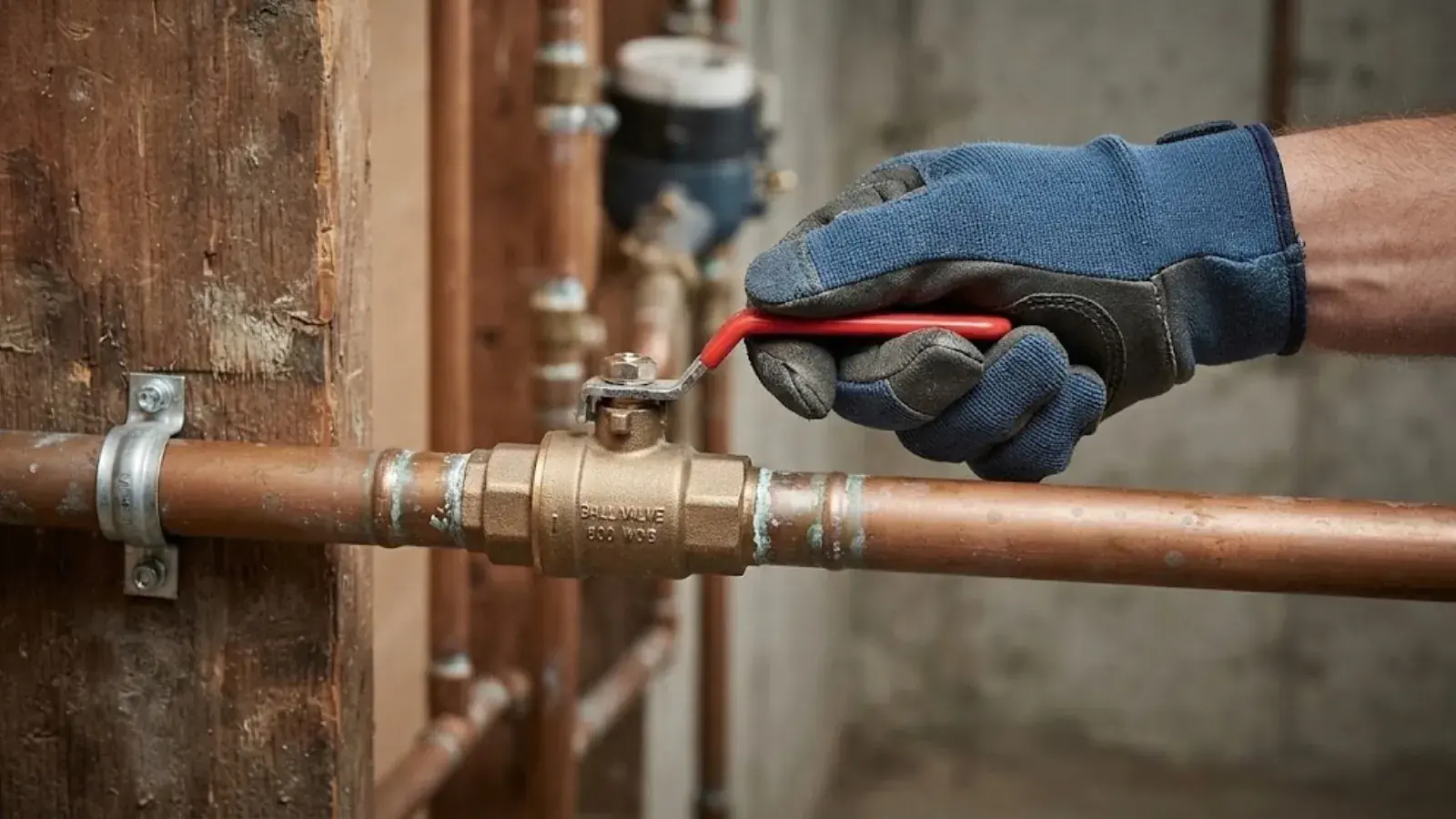
A round handle is a gate valve and a lever is a ball valve. Gate valves turn many times and can seize or break if forced, so turn them gently. A lever turns a quarter turn.
Close it and check the taps
Turn it off, open a faucet at the lowest point, and confirm the water stops. Then open the valve fully again. Never operate the utility's own valve at the meter. Use the one that belongs to you.
Label it and tell the household
Tag the valve with a bright label, and make sure every adult knows where it is. Photograph it so you can find it in the dark or send the photo to a plumber.
If the valve will not close, leaks at the stem, or breaks off, that is a plumber's job. Our water line repair team replaces main shutoff valves and the line fittings around them.
Backflow, check valves and drains: what each one does
A backflow event means water, or worse, wastewater, moves the wrong way through your plumbing. A check valve allows flow in only one direction. The two ideas show up in different places, and it helps to know which is which.
At the street level, the city has its own tidal check valves in the drainage system, which we cover in the local section below. Inside a building, a backwater valve on the building drain is a separate, private device that a plumber would install or inspect. It is not something to buy or fit yourself, and whether any permit rule covers it is something the Hallandale Beach Building Division can answer for your property.
Know your cleanout
Find the sewer cleanout, a capped pipe outside or in a utility area. Keep it accessible and clear of planters or debris. A plumber can use it to run a camera or clear a blockage quickly, and our sewer line cleaning service starts there.
Check for slow drains before the storm
A sluggish drain in dry weather is a warning. Have it cleared before heavy rain, because a partly blocked line is the first to back up when the system is under strain.
What to turn off, and when
Shutting the right thing off at the right time prevents most storm plumbing damage. Use this as a quick decision guide.
| Situation | Shut off | Why | Then |
|---|---|---|---|
| A storm is coming and you plan to evacuate | Main water valve, and the water heater's power or gas | Prevents a burst fitting from flooding an empty home | Leave a note for your plumber and association |
| A pipe or fixture is leaking | The nearest fixture valve, or the main if none | Limits the water while you wait | Call the 24/7 line |
| The power is out and water pressure is low | Nothing, until you know the cause | Low pressure may be a utility issue, not your plumbing | Check city notices |
| Water has entered the home | Electricity at the breaker only if you can reach it dry | Water and electrical systems are a shock hazard together | Leave if unsafe, call for help |
| You smell gas | Do not touch switches or valves | Gas can ignite from a spark | Leave, call 911, then your gas utility |
Prepare the water heater and appliances
Storm prep for the water heater and appliances is mostly about protecting them and keeping a source of clean water on hand.
- Check the water heater's supply and relief valveLook for rust, moisture and a discharge pipe that is intact and unobstructed. Never cap or plug the pressure relief valve.
- Secure items near the heaterMove stored boxes and chemicals away from it. A fallen item against a gas connection is a hazard.
- Check washer hoses and the dishwasher lineLook for bulging, cracks or rust on connections. A hose that fails while you are away can run for days.
- Fill containers with clean waterFill clean containers for drinking before the storm. A bathtub of water is useful for flushing toilets and washing, but should not be used for drinking.
- Know your gas shutoff, and leave it to the prosKnow where the gas meter valve is, but do not operate it unless you know how and have a reason. If you smell gas, leave and call 911 first.
Storm and tide facts for Hallandale Beach
The National Hurricane Center's climatology page gives the Atlantic season as June 1 to November 30. The City of Hallandale Beach climate page adds that king tides, the highest tides of the year, typically fall from September through November, can overflow seawalls and can rise through storm drains. That overlap means the last months of the season can bring both storm and tide risk to low-lying areas.
The city's pages say flooding was observed in 2017 in Golden Isles and along Golden Beach Drive, and the city then installed tidal check valves in those areas. If you live in either, that is a reason to take your own preparation seriously. The city's flooding page lists (954) 457-1616 or the MyHB app for reporting flooding, and the Building Division offers property drainage consultations at (954) 457-1386.
Boil water notices and outages
The City of Hallandale Beach publishes an Emergency Alert Center and utility or water outage notifications on its website, and it has posted and then lifted boil water notices for specific streets. Check those pages before you drink, make ice or brush your teeth after any loss of pressure. Follow the notice's own instructions for how long to boil.
If your building has a booster pump or a rooftop tank, a power outage may stop water even when the city's supply is fine. Ask your management company how the system works and who to call. Keep the number in your phone before the storm.
After the storm: reopening your plumbing safely
The first hours after a storm are when small plumbing problems get missed, and some become larger ones. Take it in order.
Check for hazards first
If you smell gas, leave and call 911 and your gas utility. If there is standing water near outlets or appliances, stay out of it and do not touch electrical equipment.
Look for leaks before restoring water
Open the main valve slowly and check for dripping or hissing at fixtures, the water heater and appliance hoses. If the meter keeps moving with everything off, you have a leak.
Do not use drains if sewage is backing up
Avoid flushing or running water if drains gurgle or overflow. Call a plumber. Our Pembroke Park plumbing dispatch works the same way as our main line.
Document everything
Photograph damage, note dates and keep receipts. This is for insurance claims, and for your association if the damage involves common pipes.
Get the water heater inspected if it was flooded
A heater that stood in water may have damaged controls or electrical parts. Have a plumber check it before you turn it on.
Sewer backup precautions
Sewer backups are best prevented by keeping lines clear and by limiting water use during heavy rain. Clear slow drains ahead of time, know your cleanout, and consider asking a plumber whether a camera inspection is warranted for an old line.
If a backup happens, stop using water, keep children and pets away, and avoid contact with the water. Call a plumber and your insurer. We cover Hollywood plumbers and nearby communities around the clock.
Questions homeowners ask
The Atlantic season runs June 1 to November 30 according to the National Hurricane Center. King tides also typically run September through November, so late in the season you can still face both rain and high tide flooding.
If you are evacuating, yes. Closing the main valve prevents a burst hose or fitting from flooding an empty home. If you are staying, keep it on, but know where the valve is and be ready to close it.
It is a notice telling customers to boil water before drinking because the supply may be compromised. The city publishes its Emergency Alert Center and water outage notices online, so check there and follow the instructions in any notice.
They are part of the city's drainage system and are meant to reduce tidal flooding in places such as Golden Isles and along Golden Beach Drive. They do not protect the plumbing inside your building, so keep your own preparation in place.
Yes, for flushing toilets and washing. Do not drink from it unless the tub was scrubbed and filled with clean water, and keep bottled or stored drinking water separately.
Close the nearest valve or the main, then call our 24/7 line. If you smell gas, leave first and call 911 and your gas utility before calling us.
Sources and official references
The governing standard for plumbing work in Florida is the Florida Building Code, Plumbing (8th Edition, 2023), with the 9th Edition scheduled to take effect December 31, 2026. This page is general information and not a code interpretation, so confirm requirements with the city Building Division.