
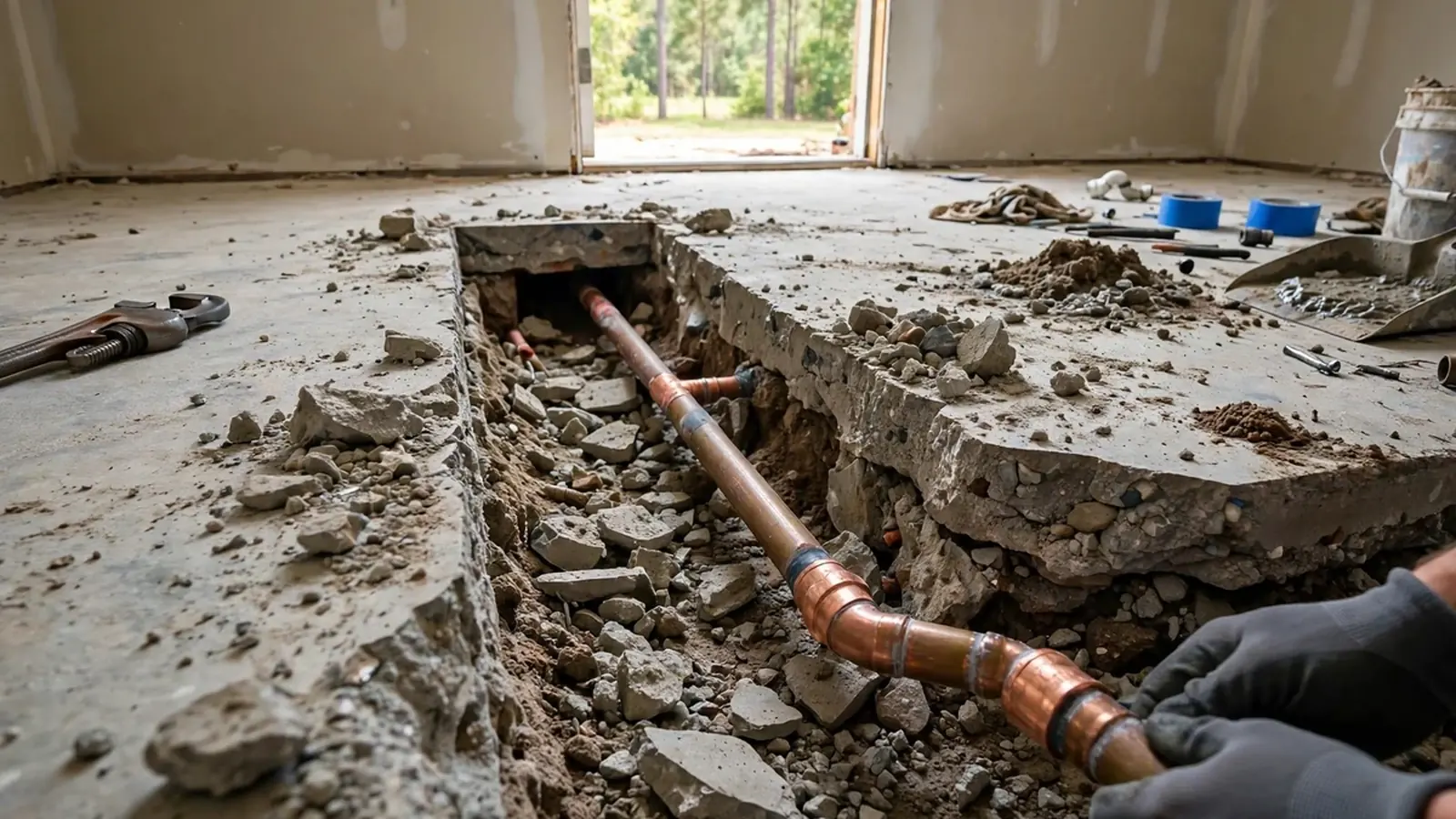
A slab leak in a Hallandale Beach house or condo is usually fixed one of four ways. A spot repair goes through the concrete. A reroute abandons the leaking line and runs a new one overhead. A lining is applied inside the existing pipe. The fourth option is a full repipe. The right choice depends on how many leaks the line has, what the pipe is made of, and how hard the floor is to reach.
Before choosing, you have to be sure the water is going under the floor. The signs overlap with a running toilet or a houseguest's long showers, so the first section below shows the checks you can run yourself with the water meter and a bare foot.
If you already see water or the meter will not stop, shut the main valve and call our 24/7 line. A pressurized line under concrete keeps leaking until someone stops it.
How to tell the leak is under the slab
No single sign proves it, but two or three together make a slab leak the likely suspect. Work through these in order.
- A meter that moves with everything offClose every tap and stop the ice maker and washer, then watch the leak indicator or low-flow dial for a few minutes. Movement means water is escaping on your side of the meter.
- A warm patch on the floorA hot line leaking under tile can warm one spot. Walk the floor barefoot in the morning, before the sun heats the room, and note where it feels different.
- Running water sounds in a quiet unitA faint hiss or trickle at night with every fixture closed points to a pressurized line. Put your ear near the floor in the room closest to the water heater.
- Damp baseboards, musty air or lifting flooringWater that reaches a slab edge or seam wicks into baseboards and grout lines. Wood and laminate can cup or lift before any puddle appears.
- Weak hot water or a water heater that runs constantlyA hot line leak makes the heater work harder to keep up. If only the hot side is weak, the leak is probably on the hot line.
Any of these is a reason to test, not proof. A toilet flapper or a dripping irrigation line can move the meter just as well, so a plumber confirms with pressure tests and listening gear before anyone cuts. Our leak detection service covers that step.
Slab leak repair options side by side
Here is how the four approaches compare. The last column is the one people forget to ask about.
| Option | What it involves | Fits best when | Main trade-off |
|---|---|---|---|
| Spot repair | Locate the leak, open a small section of floor, replace the damaged piece of pipe | One leak, pipe otherwise in good shape, floor easy to open | Other weak spots on the same line may leak next |
| Reroute overhead | Cap the leaking line under the slab and run new pipe through walls or the ceiling | Line has leaked before, or the floor finish is costly to remove | New pipe in walls means drywall work and a longer visit |
| Pipe lining | Coat the inside of the existing pipe with resin to seal it | Pipe is sound enough to hold the lining and the layout suits it | Does not suit every pipe, fitting or layout, so inspection comes first |
| Partial repipe | Replace one branch of the supply system, such as the kitchen or bath run | One zone is failing and the rest tests well | The untouched zones keep their age |
| Whole-unit repipe | Replace the supply lines throughout the home or unit | Several leaks, aging pipe, or leaks that keep returning | Largest scope, and the most disruption |
If the table points you toward replacing most of the supply system, read about repiping a Hallandale home or condo before you talk to anyone about a quote.
What each option means in practice
The table gives the outline. These notes cover the part that surprises people once the work starts.
Spot repair through the slab
The plumber pinpoints the leak, cuts and removes a section of concrete and flooring, repairs the pipe, and patches the opening. It is the most direct fix and often the least expensive in labor. The catch is that a line that has failed once in one place may be worn in others, so ask the plumber what the rest of the line looked like when it was exposed.
Rerouting the line overhead
Instead of chasing the leak in the concrete, the plumber caps both ends of the damaged run and installs new supply pipe above the floor, usually through walls and sometimes the ceiling. The slab stays closed and the old pipe is left in place unused. Expect drywall openings and patching, and in a condo expect to coordinate with your neighbors and building rules for access.
Lining the pipe from the inside
Some contractors seal a leaking line by coating its interior with a resin, which avoids breaking the floor. It is not a fit for every line, because the plumber has to inspect the pipe first to see whether it can take a lining. Ask which products are used, what condition of pipe they are meant for, and what coverage the installer puts in writing.
Repiping the affected zone or the whole unit
A repipe replaces old supply pipe with new, usually run overhead so the slab is left alone. It costs more up front than a single spot repair, but it ends the pattern of one leak after another. In a condo, replacing lines that serve only your unit is usually your decision, while shared risers are the association's business.
What Hallandale Beach housing records mean for a slab leak
Census housing tables put the median home in Hallandale Beach at 1975 construction. A home that old may still have its original supply lines, and the longer a line is in service, the more likely a second leak shows up near the first. That makes the question 'how does the rest of the line look' worth asking before you approve a spot repair.
The same Census tables show about 70 percent of the city's housing units sit in buildings of 20 or more units. If you own a condo on a ground floor, the leak may be under your floor but the pipes may not all be yours. Read your association documents or ask management before work starts, since the split between unit and building lines varies by association.
The city's Building Division page says permits are applied for through the city's online portal at its office on South Federal Highway. The page does not spell out a plumbing permit rule for a slab repair or reroute, and permit rules vary, so ask the Hallandale Beach Building Division whether your job needs one before the contractor opens the floor.
What a slab leak repair visit looks like
Knowing the sequence helps you spot a contractor who skips a step.
Stop the water and confirm
The plumber isolates the line, runs a pressure test, and uses listening gear to find the leak within a few feet. You should see the evidence, not just hear a conclusion.
Compare the options in plain terms
You get the repair choices, what each involves, and a clear price before work starts. Ask what the line looked like beyond the leak.
Protect the home
Furniture and flooring in the work area get covered or moved. Dust and noise are part of any slab opening, so plan where people and pets will stay.
Repair, then test again
After the pipe work the plumber pressure tests the line to prove the leak is gone before anything is closed up.
Close up and restore
Concrete is patched and cured. Flooring and drywall finish work is often a separate trade, so ask who handles it and when.
What drives the cost and the insurance question
Four things move the price more than the repair type alone: how deep and how accessible the pipe is, how much finished flooring has to come out, how many separate leaks the line has, and whether the work happens after hours. A spot repair under bare concrete sits at one end, and an overhead reroute through finished walls sits near the other.
Many homeowner policies cover the water damage from a sudden pipe break but treat the pipe repair itself differently, and they often exclude slow leaks over time. Ask your insurer and your condo association what applies before you authorize work, and photograph the damage first. For your real number, call the 24/7 line and describe what you found.
Questions homeowners ask
There is no safe interval. Water under a slab can soften the soil, lift flooring and raise your bill within weeks, and moisture left in place invites mold. If you suspect a leak, stop using the water you can do without and get it tested.
No. A reroute runs new pipe overhead and leaves the slab closed, and some lines can be lined from the inside. A spot repair is the one that opens the floor, and it opens only a small section once the leak is pinpointed.
Not quite. The main runs from the meter into the building, and a leak there can sit outside the slab. A slab leak is in the supply lines under your floor, and the plumber sorts out which one you have during testing.
The city's Building Division page does not state a plumbing-specific permit rule, so the honest answer is to ask. Call the Building Division at (954) 457-2220, Option 2, and describe the job. A licensed plumber can also tell you what they pull permits for.
The answer turns on your association documents and on which pipe failed. Lines serving only your unit are commonly the owner's responsibility, while shared lines are commonly the association's. Get the leak located and documented first, then take that to management.
You can if the main stays on and nothing is flooding, but the leak keeps running while you do. Turning off the main and using a bucket for essentials limits the damage if the leak is large or the floor is already wet.
Not automatically. One clean leak on a sound line often calls for a spot repair. Repeated leaks, visibly worn pipe, or several weak spots in one test point toward a repipe, and a good plumber shows you the evidence for either choice.
Sources and official references
The governing standard for plumbing work in Florida is the Florida Building Code, Plumbing (8th Edition, 2023), with the 9th Edition scheduled to take effect December 31, 2026. This page is general information and not a code interpretation, so confirm requirements with the city Building Division.