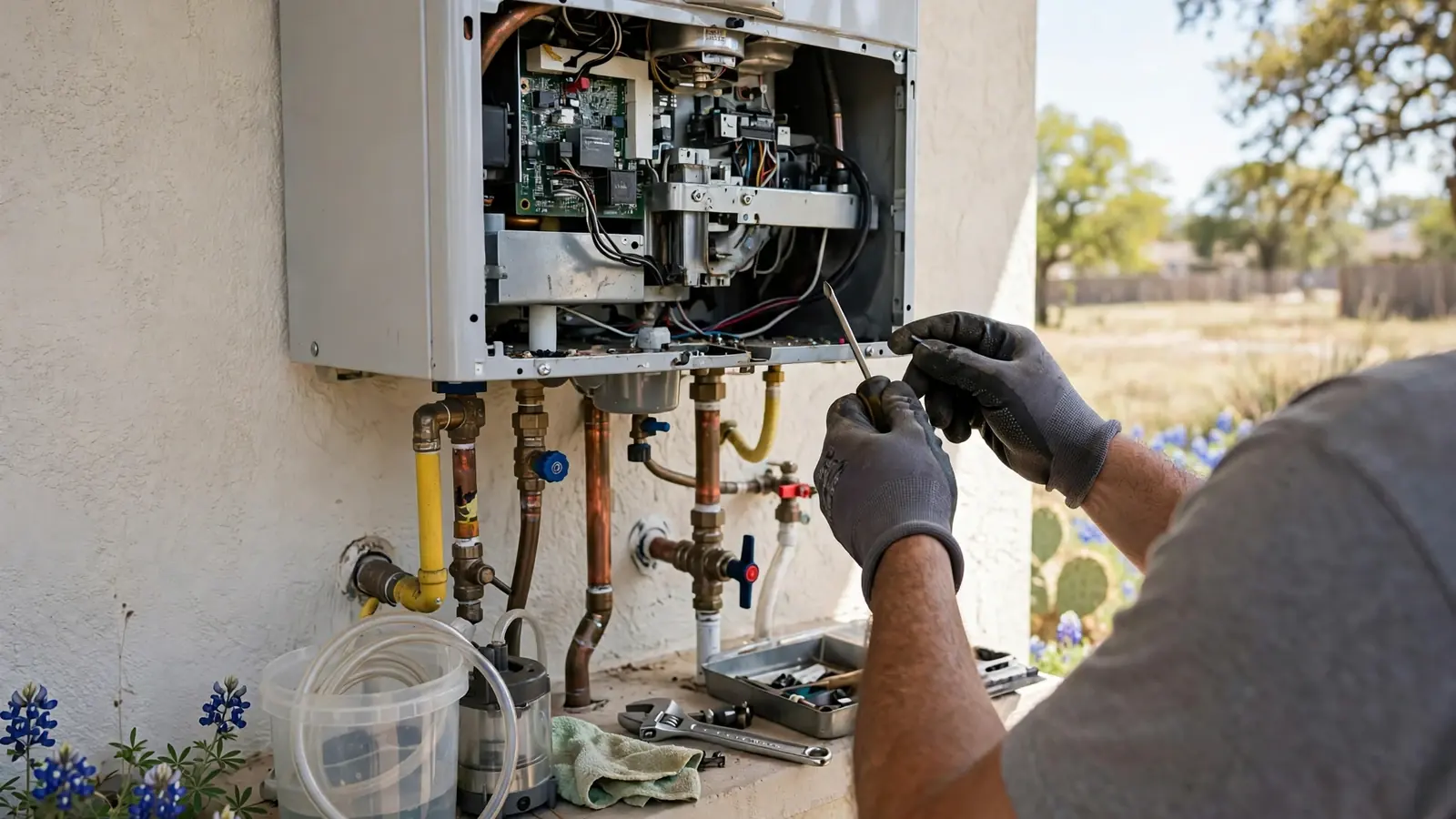
When a tankless water heater stops making hot water, the cause is usually one of five things: no power, no gas, a blocked vent, scale inside the heat exchanger, or a flow problem that keeps the burner from firing. You can safely check power, the gas shutoff position and the visible vent in a few minutes. Anything that involves opening the unit or touching a gas connection belongs to a licensed plumber.
Tankless units report trouble with a code on a small display, and the code is the best clue you have. The manual lists exactly what your unit's codes mean, so keep it nearby. This guide explains what the common groups of codes tend to point to, in general terms, so you know which checks apply.
Stop and leave if you see these
Some tankless problems are safety problems. None of these are for troubleshooting.
You smell gas near the unit
Leave the home right away, do not touch switches or phones inside, and call 911 from outside. Then call your gas utility. Call a plumber only after the gas utility says the area is safe.
A carbon monoxide alarm is sounding
Get everyone outside into fresh air and call 911. Do not go back in to reset the heater or open windows.
Soot, scorch marks or a yellow, lazy flame at the unit
Turn the heater off at its control and keep it off. Incomplete burning can produce carbon monoxide, and the unit needs a technician before it runs again.
Water on or around the unit's electrical parts
Do not touch the unit or the breaker if you are standing in water. Close the cold water inlet only if you can reach it dry, and call us.
Why you get hot, then cold, then hot again
The pattern is often called the cold water sandwich. You start a shower and get hot water, then a burst of cold, then hot again. The first hot slug is water that was already warm in the pipe, the cold burst is the water that sat cooling in the line while the heater was off, and the unit catches up once it senses enough flow to fire.
A tankless heater needs a minimum flow of water to ignite, so a very low flow from a nearly closed tap, a partly clogged aerator or a worn cartridge can leave you with lukewarm water or a heater that keeps shutting off. Open the tap further and see if the temperature steadies. If it does, the unit may be fine and a fixture is limiting the flow.
Two fixtures at once
Running a shower and a dishwasher together can ask for more hot water than one unit can heat to your set temperature. If the water is hot until a second fixture opens, the heater may simply be at its limit. Staggering use or having the plumber review the unit's size is the fix.
Long pipe runs
In a condo with the heater far from the bathroom, you wait for hot water to travel. A long wait is not a failing heater, though it can feel like one. A plumber can look at whether a recirculation setup suits your unit.
Error codes in general terms
Codes differ from one maker to the next, so use your own manual for the exact meaning. These groups are common to most units.
| Type of code | What it usually points to | Safe check | Call when |
|---|---|---|---|
| Ignition or flame failure | No gas reaching the burner, a closed valve, or a dirty flame sensor | Confirm the gas shutoff handle is parallel to the pipe, meaning open | The code returns after one reset |
| Vent or exhaust | Blocked, disconnected or damaged flue, or a condensate problem | Look at the outdoor vent termination for blockage, without climbing | Any blockage you cannot clear from the ground |
| Flow or water sensor | Low flow, a clogged inlet filter, or a faulty sensor | Open the tap fully and test another fixture | No improvement at full flow |
| Overheat or high temperature | Scale in the heat exchanger, or a failing temperature sensor | Turn the unit off and let it cool | Immediately if it repeats |
| Power or communication | Tripped breaker, loose plug, or a failed control board | Check the outlet or breaker once, then reset | The display stays dark after a reset |
For a unit that keeps throwing the same code, water heater repair is the right next step. If you are weighing a new unit rather than fixing an old one, see how a tankless water heater service visit is scoped.
Safe checks you can run in ten minutes
Do these in order. If any step feels beyond what you are comfortable with, stop.
Read the code and the manual
Write down the code and how many times it has appeared. A single code that clears after a reset is a different story from one that comes back every shower.
Check power
Make sure the unit is plugged in or its breaker is on, and that any GFCI outlet nearby has not tripped. Reset a tripped breaker once. If it trips again, leave it off and call.
Confirm the gas shutoff is open
The handle on the gas supply line should run in line with the pipe. Do not loosen a fitting or test for leaks by sniffing at joints. If you smell gas at any point, follow the safety box above.
Look at the vent from outside
Check the exhaust and intake terminations for nests, debris, blocked openings and any visible damage. Do not climb or disassemble the vent.
Open the faucets fully
Run the nearest hot tap at full flow. If the heater fires at full flow but not at low flow, the issue is flow related.
Power cycle once
Turn the unit off at its control, wait a minute, and turn it back on. A repeat of the same code means it needs a technician.
Hallandale Beach water and permits: what they mean for a tankless unit
The City of Hallandale Beach's 2025 water quality report says the city draws groundwater from the Biscayne Aquifer and disinfects with chloramines. The city softens its water at the plant, but its published reports do not list a hardness figure, so nobody can honestly tell you your scale rate from the report. Test your tap with a hardness kit, and ask the city's Utilities Division for its current report, before you settle on a flushing schedule for the heat exchanger.
Scale matters more for a tankless unit than for a tank, because the small passages in a heat exchanger can narrow and trigger overheat or flow codes. A plumber can flush the unit with a descaling solution through isolation valves, and how often depends on what your own water test shows.
On permits, the city's Building Division publishes a Water Heater Replacement Data Form for replacements, but the form does not state a rule in words. Permit rules vary, so ask the Hallandale Beach Building Division whether swapping to a tankless unit, with its gas, electric and venting details, needs a permit at your address.
When to stop troubleshooting and call
Call a licensed plumber if the same code returns after one reset, if the unit shows an overheat or flame code more than once, if there is any water leaking from the unit, or if you hear banging or sharp popping during operation. Those point to scale, a failed part or a venting problem, not a quick fix.
Skip the call and get out first if there is gas, soot or a carbon monoxide alarm. Otherwise, our 24/7 line is open, and same-day appointments are available when schedules allow. Tell us the code, the age of the unit and what you already checked.
Questions homeowners ask
A code that clears after a reset often points to a passing condition, such as a short drop in gas pressure, a low flow moment or a dirty sensor. It is worth writing down because a pattern of repeat codes suggests a part is starting to fail.
Most do over time. How fast scale builds depends on your water, and the city's reports list no hardness figure, so test your tap and ask the Utilities Division for the current report. Then ask the plumber for a flushing interval that matches your result.
Yes, once. Turn it off at the control, wait a minute and turn it back on. If the same code returns, the problem is still there and repeated resets can hide it.
Common causes include low flow through a fixture, a partly blocked inlet filter, scale narrowing the heat exchanger, or a temperature setting that was changed. Try a different fixture first. If every fixture is lukewarm, the unit needs a look.
Usually not. It comes from the way a tankless unit waits for flow, and from cooled water sitting in the pipe. If it is extreme or new, ask the plumber to check the flow settings and the fixtures.
Looking at the outdoor termination from the ground is safe. Taking apart the venting, climbing to a roof or clearing a flue is not. Leave blocked or damaged venting to a licensed plumber.
We take water heater calls at any hour. For a leak, close the cold water inlet to the unit if you can reach it safely. For gas or carbon monoxide, leave and call 911 first.
Sources and official references
The governing standard for plumbing work in Florida is the Florida Building Code, Plumbing (8th Edition, 2023), with the 9th Edition scheduled to take effect December 31, 2026. This page is general information and not a code interpretation, so confirm requirements with the city Building Division.