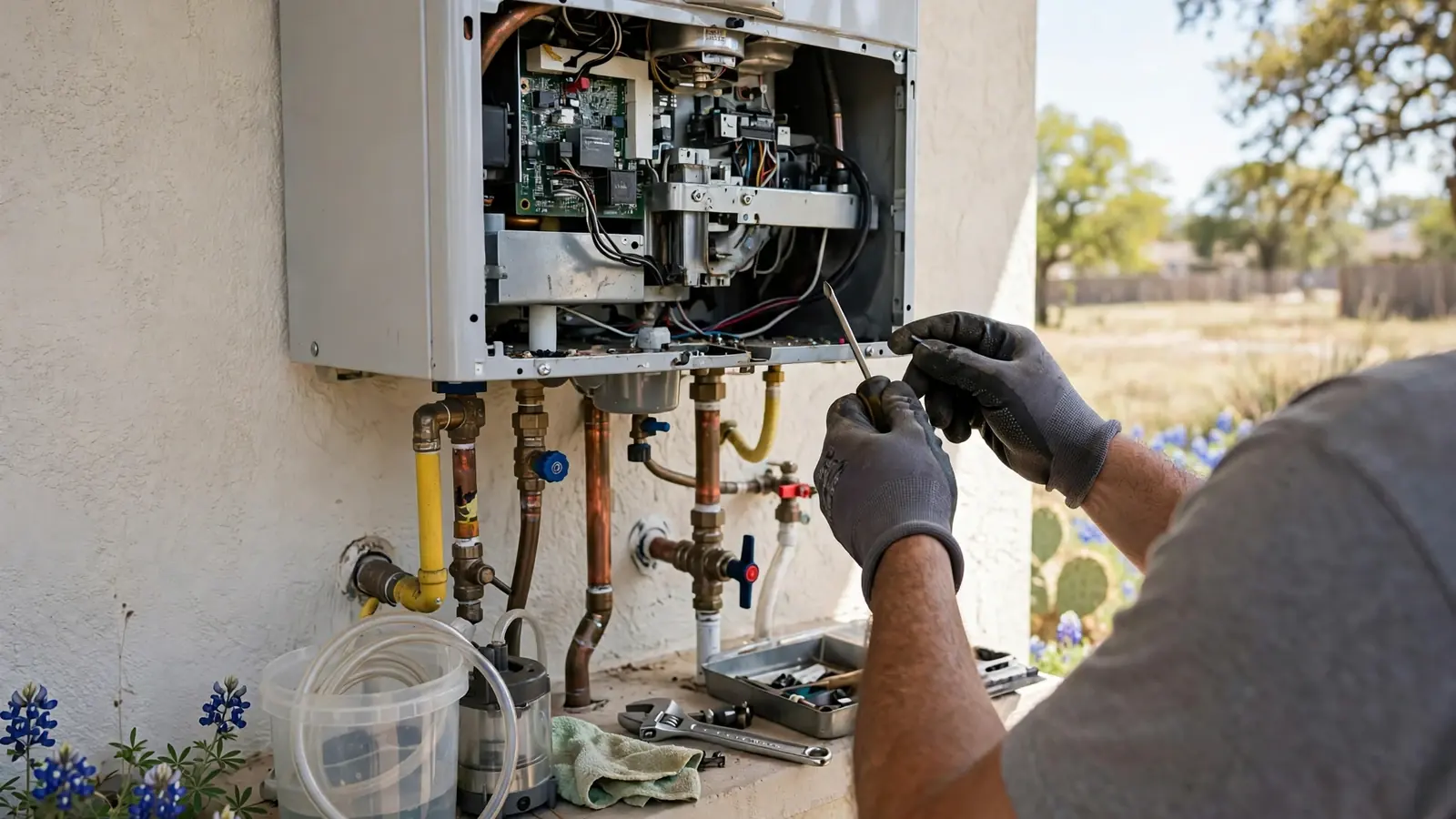
Tankless water heater service in Hallandale covers three jobs: installing a new on-demand unit, repairing one that has stopped working, and flushing or descaling one that has lost performance. Calls on all three are welcome at any hour, and same-day visits can be had when the schedule allows.
A tankless unit heats water as it flows instead of storing it, so there is no tank to leak and no standby heat to maintain. The trade-off is that the unit needs the right gas or electric supply, a proper vent for gas, and regular maintenance to keep mineral buildup from choking the heat exchanger.
Plenty of calls we hear are about the maintenance side. A unit that runs cold, flickers between hot and warm or throws an error code often needs a flush before it needs a part.
Signs a tankless heater needs attention
These symptoms are common, and many point to buildup or a supply problem rather than a failed unit.
- Hot water that fades or runs lukewarmMineral scale narrows the heat exchanger and cuts heat transfer. A descale often restores output.
- Water that swings between hot and coldLow flow, a clogged inlet filter or scale can make the unit shut down and restart. It can also be a sizing issue.
- Error codes or a unit that will not fireCodes point to a cause, such as ignition, venting, flow or temperature. We read the code and test the part it names.
- A longer wait for hot water at the tapSome delay is normal because water has to travel from the unit. A bigger delay may mean low flow or scale.
- Rising gas or electric billsA scaled heat exchanger works harder to do the same job, and usage creeps up.
- Noise, popping or a smell of exhaustScale can cause rumbling. An exhaust smell is a safety issue: leave, call 911 and your gas utility, then call us.
How we install, repair and descale a tankless unit
The process depends on the job, but the order is similar for each.
Check the supply and the setup
We confirm the gas line size or the electrical capacity, the venting path and the water flow the unit has to deliver.
Read the unit and test it
For repair we pull error codes, test igniters or elements, check sensors and inspect the inlet filter and the vent.
Flush and descale
We isolate the unit, circulate a descaling solution through the heat exchanger with a small pump, and rinse it clean. Regular flushing is the usual way to slow scale.
Install or reconnect
For a new unit, we mount it, connect water, gas or power, run the vent and add isolation valves that make later flushing easy.
Test flow and temperature
We run hot water at several fixtures, check temperature rise and confirm the unit holds steady.
Tankless water heaters in Hallandale Beach buildings
The Census puts the median home here at 1975 construction, with seven in ten units in buildings of 20 or more. In a condo, a tankless unit has to fit a small closet or wall space, and a gas model needs a vent path that the building allows.
That is why many condo owners end up with an electric unit, if the unit's panel can carry it, or stay with a tank. Before you buy, ask management whether the building allows a change of heater type and where a vent could run. The answer shapes the whole project.
Gas or electric
Gas units give high flow but need a gas supply and a vent. Electric units are simpler to place and vent-free, but they draw heavy power, and your panel or wiring may limit the size. We check both before recommending one.
Water quality and scale
Hallandale Beach pulls groundwater from the Biscayne Aquifer and softens it at the plant, though its published reports give no hardness figure. To see what your tap carries, request the annual water quality report from the Utilities Division. Scale builds on any heater, so a flush schedule is worth keeping.
Planning a swap or a flush
If you are switching from a tank, ask three questions first. Does the home have the gas line or electrical capacity? Can the unit vent safely? Does your building allow the change?
If you already have a tankless unit, find the installation date and the last flush date, if there was one. That history tells us whether a descale is likely to fix the problem.
Tankless versus tank: how they compare
Neither type is always better. This table shows how they compare on the points that usually decide the choice.
| Point | Tankless | Tank |
|---|---|---|
| Hot water supply | Continuous, limited by flow rate | Limited by tank size, then recovery |
| Space | Compact, wall mounted | Floor space for the tank |
| Supply needs | Large gas line or heavy electric circuit | Standard gas or electric supply |
| Venting | Gas models need a dedicated vent | Gas tanks need a flue |
| Maintenance | Regular flushing to remove scale | Occasional flush and anode check |
| Leak risk | No tank to fail, but fittings can leak | A tank can corrode through |
If you are not sure which suits you, our page on water heater installation walks through the planning, and water heater repair covers tank units that are failing.
What affects the cost of tankless work
Naming a price without seeing the unit would be a guess. Your clear price comes before work starts and follows these points.
Wear, scale and upgrades are rarely insured, though sudden water damage can be. Your insurer or association can clarify. For a number on your unit, call and we book a visit.
Keeping a tankless unit running
Flush the unit on a regular schedule, and clean the inlet filter when you do. Keep the vent clear of nesting and debris, and do not store anything flammable near a gas unit.
Do not open the cabinet or work on gas or electrical parts yourself. A short flush visit costs far less than replacing a heat exchanger. If you serve a rental or a small building, Pembroke Park and Hallandale owners can also call us about commercial plumbing units.
Questions homeowners ask
Many makers call for an annual flush, and more often where water leaves heavy scale. We look at the unit's history and the water to suggest a schedule. If yours has never been flushed, start now.
Flow rate is how many gallons per minute the unit can heat to your set temperature. If several fixtures run at once, you need enough capacity for all of them. An undersized unit gives lukewarm water when demand is high.
Often yes, especially an electric model, but it depends on your panel capacity, the closet and the building's rules. Ask management before you buy, then call us to check the setup.
Gas models do, and the vent path has to be safe and approved. Electric models do not burn fuel, so they do not need a vent.
Codes point to ignition, flow, venting or temperature problems. Scale and a clogged filter are common causes. We read the code, test the part it names and explain the fix.
Permit rules vary, so ask the Hallandale Beach Building Division how your project is handled. The city also publishes a form for water heater replacements, and we can go over it with you.
Sources and official references
The governing standard for plumbing work in Florida is the Florida Building Code, Plumbing (8th Edition, 2023), with the 9th Edition scheduled to take effect December 31, 2026. This page is general information and not a code interpretation, so confirm requirements with the city Building Division.