
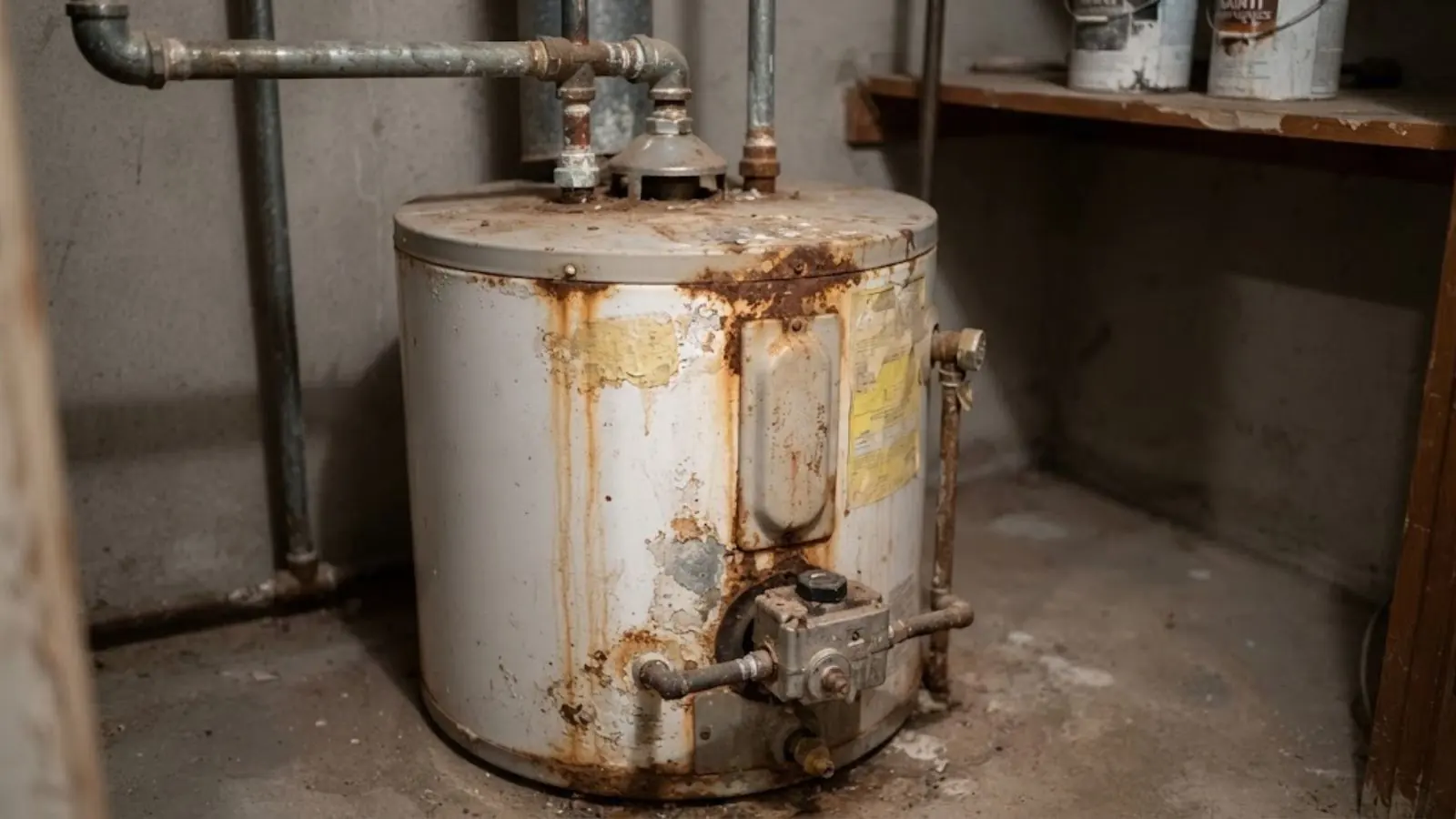
Emergency water heater replacement in Hallandale begins when the tank fails and water is on the floor. Call our 24/7 line, then shut the cold water valve above the heater, switch off power or gas to the unit, and keep clear of the puddle until we arrive.
Replacement is the right call when the steel tank itself has rusted through, when repairs have piled up, or when an old unit fails again soon after a fix. We lay out the repair and replace choices side by side, then handle removal of the old tank, hookup of the new one and the paperwork around it.
Same-day appointments are offered when available, and after-hours dispatch covers the rest. The permit step is real, and we walk you through what the City of Hallandale Beach publishes so there are no surprises.
Signs your tank is past saving
Age matters, but condition matters more. These are the signs that usually mean the tank is finished, not just the parts around it.
- Water seeping from the tank body or bottom seamMetal that has corroded through cannot be patched. This is the clearest sign that replacement is the only sound option.
- A tank that has been running for many yearsMost tanks wear out gradually, and the age printed on the data label helps us judge. An older unit with a new problem often costs more to fix than to replace.
- Rust-colored hot water or flakes in the waterRust that appears only in hot water points to corrosion inside the tank, which tends to get worse.
- Repeated repairs in a short stretchWhen the second or third part fails within months, the repairs are buying time, not fixing the cause.
- Not enough hot water for the household anymoreSediment and a worn heating system shrink usable hot water. A larger or different type of unit may suit current use better.
- Visible rust or moisture around fittings and the baseCorrosion at the connections often means the tank interior is not far behind.
If the symptoms are milder, such as a bad thermostat or a dripping relief valve, our water heater repair service is usually the better first step.
What replacement looks like in Hallandale Beach housing
Per the Census, the median home in Hallandale Beach was built in 1975, and nearly 70 percent of units are in buildings with 20 or more units. Many replacements are therefore condo closet jobs, where the old tank has to come out through a narrow door and the new one has to fit the same space.
That is why measurements matter. A closet sized for a smaller unit may not take a taller or wider replacement, and some buildings have rules about contractor hours or freight elevator access. Tell us your building's rules when you call and we plan around them.
The city's replacement paperwork
The City of Hallandale Beach publishes a Water Heater Replacement Data Form. It is a supplement to the Broward County Uniform Building Permit Application, and it asks for details on the existing and new unit, electrical or gas information, and an efficiency certificate for the new heater. Having that information ready speeds the permit step.
Permits and timing
Permit rules vary, so ask the Hallandale Beach Building Division what applies to your address. The Building Division is at 400 South Federal Highway, and its published hours run Monday through Thursday with City Hall closed on Fridays. If you are replacing late in the week, start the paperwork early.
Repair or replace: how to decide
This table puts the usual deciding factors side by side. If most rows point to the right-hand column, replacement is usually the better value.
| Factor | Repair makes sense when | Replace makes sense when |
|---|---|---|
| Where the leak is | A fitting, valve or connection | The tank body or bottom seam |
| Age of the tank | Newer, with one failed part | Near or past its expected life |
| Repair history | First problem in a long stretch | Second or third problem in a short stretch |
| Hot water demand | Household needs are unchanged | Needs have grown or the supply runs short |
| Safety and condition | No rust or corrosion on the tank | Rust, scorching or a failing burner |
| Cost of the fix | Small compared with a new unit | Close to the price of a new unit |
If the leak is not coming from the heater at all, leak detection pins down the real source.
Flooding from a failed tank: what to do right now
A split tank can release dozens of gallons quickly. These steps limit damage while a replacement is arranged, including after-hours.
Water is spreading across the floor
Close the cold supply valve above the heater. If that valve is stuck, close the unit or main shutoff instead, and move belongings off the floor.
The heater is electric and the floor is wet
Flip the heater's breaker only when the panel is on dry ground. If not, call us and the utility or building management.
The heater is gas and you smell gas
Leave immediately, call 911 from a safe place, and call your gas utility. Do not call a plumber first and do not touch switches.
Water is reaching a neighbor's unit
Tell building management right away and call our 24/7 line. A fast shutoff and a documented source limit the damage and the paperwork.
Gas, electric and hybrid: choosing the type
A gas heater needs a vent path and a gas supply, which limits where it can go and is often not possible in a condo with no existing gas line. An electric tank needs a suitable circuit and is the simpler swap where gas is not available. A hybrid unit, which uses a heat pump to move heat into the tank, typically needs more space and airflow around it.
Switching types changes the job. Moving from gas to electric, or to a hybrid, may involve new wiring or venting changes, and the building may need to approve it. Tell us what you have and what you want, and we say what is practical in your space.
How a replacement visit goes
The work follows a set order so the new unit is safe and the old one is removed cleanly.
Confirm the diagnosis and the size
We verify the tank is the failure point, note the fuel type and read the data label so the new unit matches your household's hot water use.
Shut off and drain the old unit
Power or gas goes off, the water supply is closed and the tank is drained to a safe point before disconnecting.
Remove and haul away
The old tank is disconnected, carried out and taken away, with floor and walls protected along the route.
Set and connect the new unit
We set the heater, connect water, gas or electric, and the relief valve and discharge line, then check for leaks.
Test and walk you through it
We bring the unit up to temperature, test the controls and show you the shutoff and the settings before we leave.
What drives the cost of a replacement
Quoting a heater sight unseen would be guessing. Your clear price arrives before work begins, and it follows these factors.
Insurance often pays for sudden water damage from a failed tank but usually not the tank itself, so check your policy or your association's master policy. To get a real figure for your heater, phone the 24/7 line.
Before the new heater goes in
Photograph the old heater, its data label and any water damage. Clear a path from the closet to the door, and ask management about elevator or parking access if you live in a condo.
If you have a choice, decide whether you want the same fuel type or a change before we arrive. Switching is possible in many homes, but it changes the job and the paperwork.
Questions homeowners ask
Yes. For a failed tank we make the area safe first, then arrange the replacement as soon as the right unit and a licensed plumber are available, which can mean the same day.
Permit rules vary, so ask the Hallandale Beach Building Division what applies to your address. The city publishes a Water Heater Replacement Data Form that supplements the Broward County Uniform Building Permit Application, and we help you gather the details it asks for.
The form asks for details on the existing and new unit, the electrical or gas information and an efficiency certificate for the new heater. We read the data label on the old unit and the specs on the new one, so it is filled out accurately.
Often yes, but it changes the job. Electric and hybrid units need suitable power, and a hybrid also needs space and airflow. In a condo, building approval may be part of the process, so ask management first.
Look for water at the base of the tank, rust in the hot water or repeated repairs. The data label shows the age, and an older unit with a new fault is often a replacement candidate. We tell you honestly which side your tank falls on.
Yes. We drain, disconnect, carry out and haul away the old tank as part of the replacement, and we protect the floors and walls along the way.
It can be, depending on your gas or electric supply, venting and space. Our tankless water heater page explains what to check, and we can look at your setup.
Sources and official references
The governing standard for plumbing work in Florida is the Florida Building Code, Plumbing (8th Edition, 2023), with the 9th Edition scheduled to take effect December 31, 2026. This page is general information and not a code interpretation, so confirm requirements with the city Building Division.