
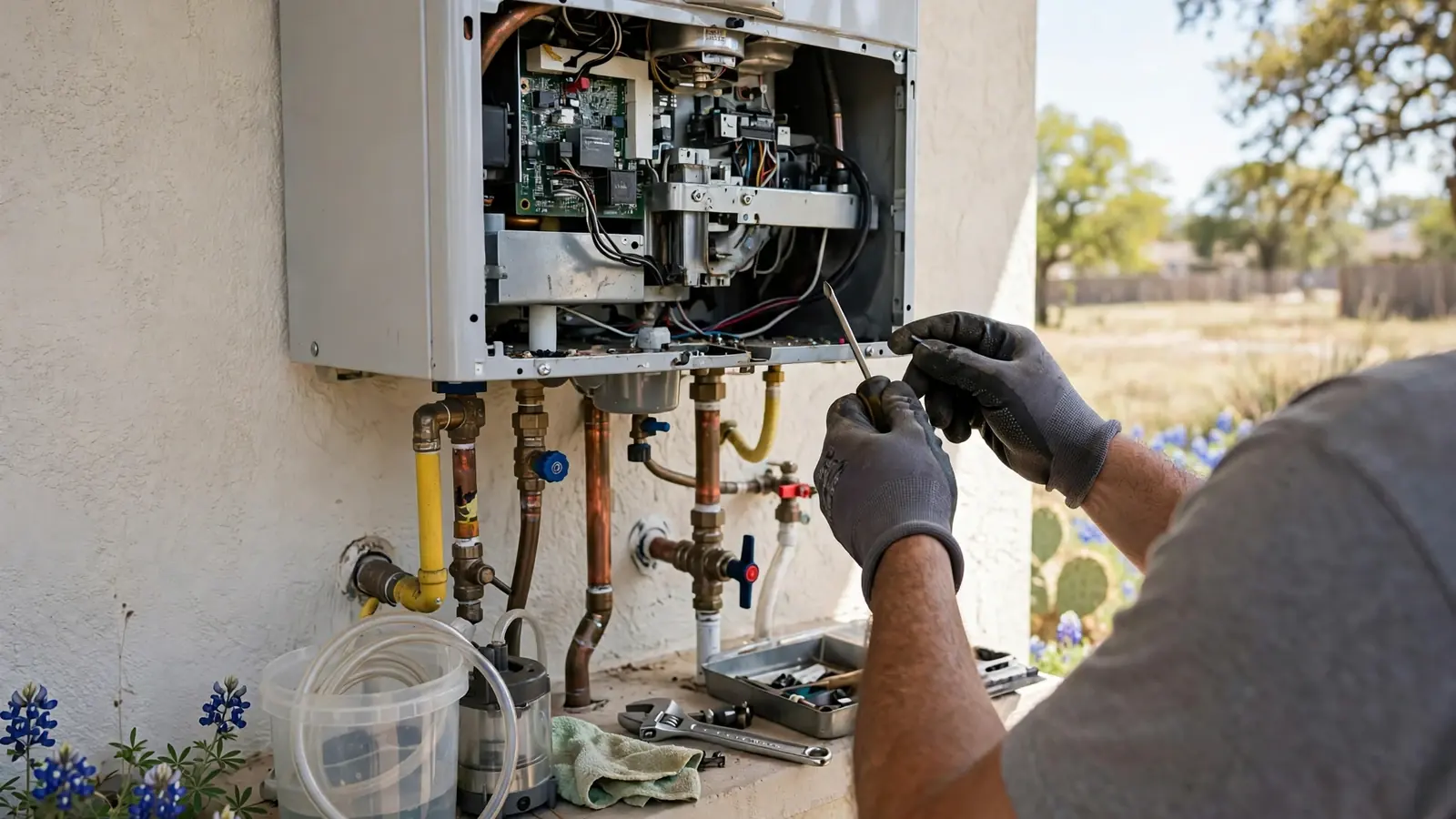
The size of a gas tankless water heater is set by two numbers: the flow rate you need in gallons per minute, and the temperature rise from the incoming cold water to your hot setting. Add up the fixtures you run at the same time, find the rise, and the unit's rating should cover both.
A tankless heater does not store hot water. It heats water as it flows, so a unit that is too small gives you lukewarm water when two fixtures run together. One that is too large costs more up front than you need.
Below is the method, a worked example with round numbers, and the questions about gas line capacity, venting and building rules that a plumber has to answer for your address. If your building has no gas service, we also cover the electric alternative.
Step one: count what runs at the same time
Do not count every fixture in the home. Count the ones that are likely to run together at your busiest moment, like a morning shower while the dishwasher runs.
List your hot water fixtures
Showers, bath fillers, kitchen sink, bathroom sinks, dishwasher and clothes washer. Skip fixtures that rarely overlap.
Find each fixture's flow rate
Look for gallons per minute (GPM) on the fixture, the box or the manufacturer's page. Use the label before any rule of thumb.
Pick your realistic peak
Choose the combination you actually use at once. A household with two bathrooms often runs two showers together, not five fixtures.
Add the flow rates
The total is the flow rate the heater must deliver at your needed temperature.
When you are ready to compare units, our tankless water heater service page explains what the plumber looks at on site.
Step two: the temperature rise
Temperature rise is the number of degrees the heater must add. It equals your target hot water temperature minus the temperature of the water coming in. A bigger rise means the heater has to work harder, so its flow capacity at that rise is lower.
South Florida's incoming water is usually warmer than in northern states, which helps. We will not give you a local figure for it, because none was verified for Hallandale Beach. Measure your own cold tap with a thermometer, or ask the plumber to check it. The water temperature changes with the season, so size for your coolest month to avoid surprises.
A worked example with round numbers
These numbers are an illustration, not a quote. Assume a household that runs two showers and one kitchen faucet at the same time, a cold tap at 75 degrees, and a hot setting of 120 degrees. The temperature rise is 45 degrees (120 minus 75).
| Item | Assumption | Result |
|---|---|---|
| Two showers | 2.0 GPM each | 4.0 GPM |
| One kitchen faucet | 1.5 GPM | 1.5 GPM |
| Total flow needed | Add the three | 5.5 GPM |
| Temperature rise | 120 degrees minus 75 degrees | 45 degrees |
| Heat required | GPM x rise x 500 | About 123,750 BTU per hour |
| What to shop for | A unit rated to deliver 5.5 GPM at a 45 degree rise | Confirm on the maker's chart |
The 500 in the formula is a standard constant for heating water. Real units lose some heat, so the rated input is higher than the output you calculated. Use the maker's published flow-at-rise chart, and let your plumber confirm the choice for your fixtures.
What the plumber has to check on site
Sizing the heater is only half the job. Gas tankless units draw a lot of gas at once, and they need proper exhaust. These are questions to ask, not answers we can give without seeing your home.
- Is the gas line big enough?A tankless heater can need a larger gas pipe or a higher gas capacity than the old tank did. Ask the plumber to check the line size and meter capacity.
- Where will it vent?Gas units need a vent path to the outside. Ask what vent type the unit needs and whether your wall or roof can accommodate it.
- Is there room and clearance?Check the space around the unit and the distance to combustibles. Ask for the maker's installation clearances.
- Does it need a condensate drain?Some high-efficiency units produce condensate that must drain away. Ask whether the model you chose does.
- What about the water side?Ask about shutoff valves, a pressure relief arrangement and how the unit ties into your existing piping.
If you ever smell gas, leave the building right away and call 911 and your gas utility from a safe place. Do not use switches or phones inside. Call a plumber only after the area is safe.
Hallandale Beach buildings and permits
The City of Hallandale Beach publishes a Water Heater Replacement Data Form on its Building Division forms page. The form asks the applicant to supply existing and new unit specifications and either electrical or gas details, and it is a supplement to the Broward County Uniform Building Permit Application.
So when you plan a tankless swap, your plumber will need the unit specs and fuel details ready. Permit rules vary, so the Hallandale Beach Building Division is the place to ask what applies at your address.
Census data shows about 70 percent of the city's housing units sit in buildings of 20 or more units. In a condo, your association may control gas lines, vents through exterior walls and shared riser capacity. Ask for the written rules before you buy a unit, because a gas tankless heater that cannot vent is not installable.
No gas in the building? Electric is the path
If your building has no gas service, a gas tankless unit is off the table. Electric tankless heaters need no gas line and no flue, which can suit a condo with limited venting. They do draw a large electrical load, so a licensed electrician has to confirm that your panel and wiring can support the unit.
We do not claim that gas service reaches every Hallandale Beach address. Check your utility bill, or ask your association or the gas utility whether your building has service. An electric tankless unit or a tank-type heater may be the better match for your unit.
Tankless or tank: a quick comparison
Size is only one part of the choice. This table shows the trade-offs in plain terms.
| Type | How it works | Strengths | Questions to ask |
|---|---|---|---|
| Gas tankless | Burner heats water as it flows | Continuous hot water, small footprint | Gas line size, vent path, building rules |
| Electric tankless | Electric elements heat water as it flows | No gas or vent needed | Panel capacity, wiring, electrician needed |
| Tank-type | Heated water stored in a tank | Simple, familiar installation | Space, size of tank, standby heat loss |
For a swap of an existing unit, see our water heater installation page. If your current tank has failed, water heater replacement covers the whole process. The same 24/7 dispatch covers Hollywood customers and Pembroke Park customers.
Questions homeowners ask
It needs to supply the total flow of the fixtures you run at once. Two showers and a kitchen faucet at 2.0, 2.0 and 1.5 GPM add to 5.5 GPM. Check your fixtures' labels for the real values.
It is the number of degrees the heater adds, equal to the hot setting minus the incoming cold water temperature. A larger rise lowers the flow a given unit can deliver.
Bathrooms are a starting point only. What matters is how many fixtures run together and their flow rates. Two bathrooms may need less than you think, or more if the kitchen overlaps.
Often it does. Ask the plumber to check the line and the meter capacity. This is a question to answer on site, not by guess.
Only if the building has gas service, and the association allows the venting. Ask management for the written rules and about shared gas and riser limits before you buy.
Electric is the path. An electric tankless or a tank-type heater suits buildings without gas. A licensed electrician should confirm the electrical capacity first.
Sources and official references
The governing standard for plumbing work in Florida is the Florida Building Code, Plumbing (8th Edition, 2023), with the 9th Edition scheduled to take effect December 31, 2026. This page is general information and not a code interpretation, so confirm requirements with the city Building Division.